



This article explains how the approach to customer support in travel flips between two phases: before a trip, when a problem can still be fixed, and after it, when the trip already happened and can only be made good. You will get a plain definition of each phase, a mode switch reference table, a real booking walked across the departure line, and a way to run both without one dragging the other down. It is written for operations and support leaders at any travel company.
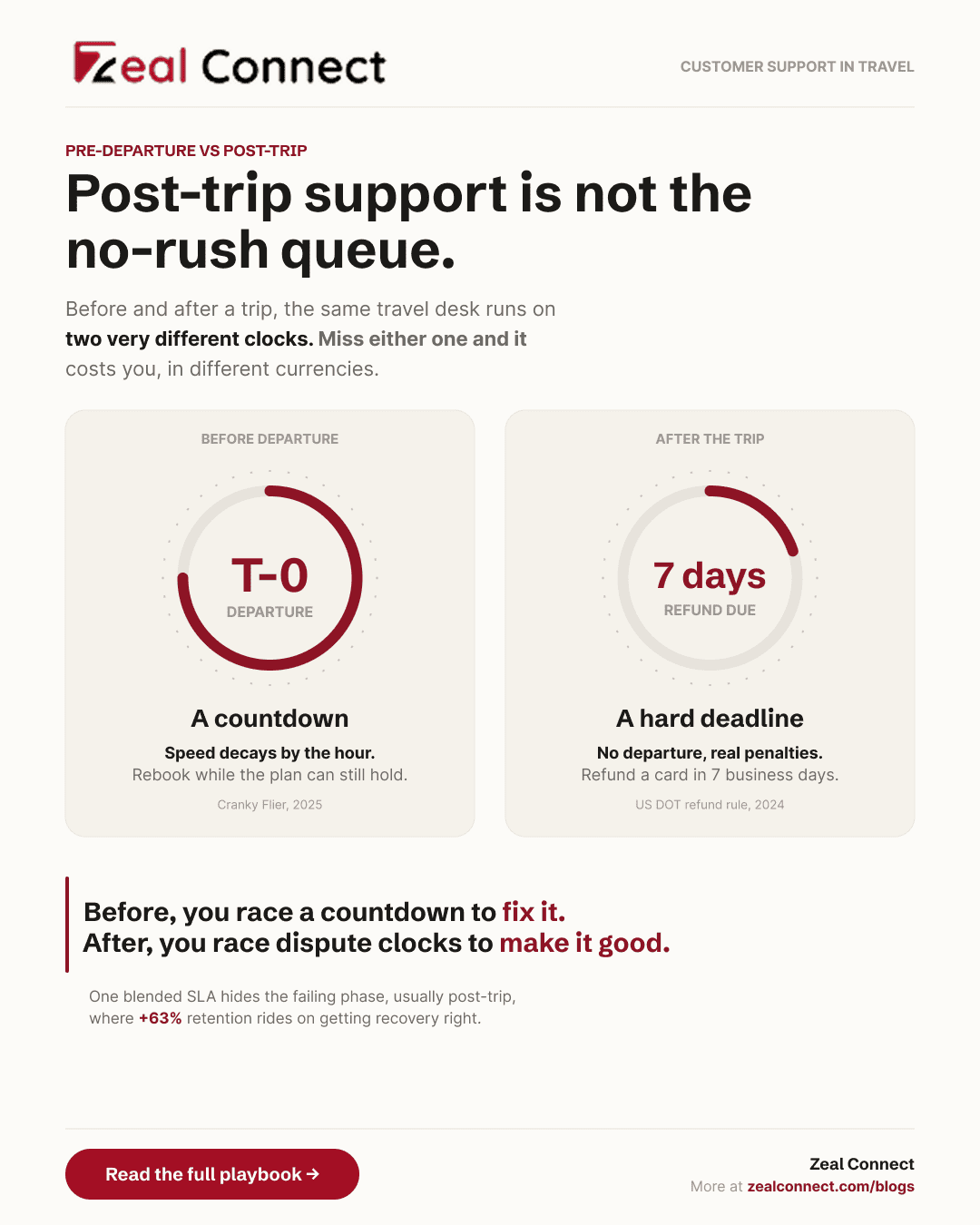
Picture one booking and two support requests three weeks apart. First, a schedule change lands 72 hours before departure, and you can still fix it. Then, weeks after the traveler is home, a complaint and a refund claim arrive about something you can no longer change. On most teams, customer support in travel treats both as the same job on the same desk. But the departure moment quietly flips what support is for, and handling both the same way is where the post trip side breaks.
Customer Support in Travel Is Really Two Jobs Divided by the Departure Date
Customer support in travel is really two jobs wearing one badge. Before a trip, the work protects a plan that can still change. After it, the work repairs something that already happened. Most desks run both through one queue, one SLA, and one set of habits. That holds up until the two jobs start pulling in opposite directions, which they always do.
Most Travel Teams Run Pre Departure and Post Trip Support on One Playbook
One inbox, one rota, one target response time. That is how most travel companies handle every contact, whether it arrives before a trip or long after it. The setup is efficient on a calm day. The strain shows up when a pre departure spike and a post trip backlog compete for the same agents. Speed first habits then get applied to complaints that need evidence, while careful investigation gets applied to a traveler who boards in six hours.
Why Does the Same Support Desk Handle Both So Unevenly?
Because the two phases reward opposite instincts, and a single playbook can only favor one. Pre departure work is fast and mostly predictable, so it tends to look healthy. Post trip work is slower, disputed, and easy to defer, so it quietly piles up. The volume is not shrinking either. According to CBS News (2025), US airlines drew a record 66,675 consumer complaints in 2024, with total complaints up 9% while passenger numbers rose only 4%. Post trip demand is growing faster than the traffic behind it.
Both Ends of the Trip Are Getting Heavier
Pre departure is not calm either. Airline schedules change constantly, so a confirmation rarely stays final for long. On one peak day in September 2025, of the 6,500 American Airlines flights filed to operate, only 481, about 7.4%, saw no change at all (Cranky Flier, 2025). Each of those changes can become a pre departure contact, and none of it replaces the post trip work waiting behind it. Industry watchers now expect the winners to be companies that solve post booking servicing at scale. Neither end of the trip can be starved to feed the other.
What Pre Departure and Post Trip Customer Support in Travel Actually Mean
Pre departure customer support helps a traveler before a trip begins: confirming bookings, making changes, collecting documents, and handling disruption while the plan can still be fixed. Post trip customer support handles what comes after the trip ends: refunds, complaints, and claims about something that already happened and cannot be undone. The dividing line is the trip itself, and one word explains the gap: reversibility.
Before departure, almost any problem still has a fix. After the trip, the same problem is frozen in place, and all you can offer is a remedy.
Pre Departure Support: Protecting a Trip You Can Still Fix
Everything before departure runs against a countdown. A traveler needs a confirmation, a visa letter, a seat change, or a rebooking after a schedule change, and the value of your reply drops by the hour as departure nears. The upside is that most of this work is predictable. The requests repeat, the data is structured, and the right answer usually sits in a booking record already. Speed and completeness matter here far more than deliberation.
Post Trip Support: Making Good on a Trip That Already Happened
After the trip, speed alone fixes nothing, because the thing the traveler wanted, a good trip, is already gone. What remains is a fair remedy and a clear record of it. These cases turn on evidence: what was promised, what was delivered, and what the traveler is owed. They also carry money and rules. Under US DOT rules (via AARP, 2024), a refund owed on a credit card booking must be issued within seven business days, so post trip work has hard deadlines of its own.
The Departure Line: How the Two Support Modes Differ
The table below sets the two modes side by side, decision by decision. Read the last column closely, because it shows what goes wrong when a team carries one mode's habits across the departure line. That carry over is the single most common way a good travel desk lets its post trip support slide.
Table: The departure line, how customer support in travel switches modes before and after a trip
| Operating decision | Pre departure mode | Post trip mode | What breaks if you run the wrong mode |
|---|---|---|---|
| The job | Prevent and execute while the trip can still be fixed | Remedy, prove, and recover after a trip that cannot be undone | Rush post trip and refunds go out with no record; stall pre departure and the traveler misses the flight |
| The clock | Countdown to a fixed departure, where hours matter | Refund windows, chargeback windows, review decay, over days to weeks | Miss the departure clock and the trip is ruined; miss the refund clock and you face a forced payout |
| Emotional register | Anxiety and anticipation: reassure and confirm | Disappointment or anger: acknowledge and make good | A reassurance script sent after a ruined trip reads as dismissive and earns a public review |
| What automates well | Confirmations, reminders, documents, self service changes, status | Little, because evidence and goodwill need judgment | Auto answering a complaint like a booking FAQ escalates it into a dispute or chargeback |
| The governing metric | First response time, confirmation completeness, deflection | Resolution quality, refund accuracy, recovery and retention | One blended SLA across both hides the phase that is failing, usually post trip |
Key Terms Worth Knowing
- Reversibility (the departure line): the point after which a trip problem can no longer be prevented or fixed, only remedied. It is the single fact that separates pre departure support from post trip support.
- Service recovery: the structured process of making good after a failure, from acknowledgment to resolution, and the customer loyalty it earns back when handled well.
- Chargeback / dispute window: the deadline within which a traveler can dispute a charge with their bank or card network, which turns a slow post trip refund into a hard financial risk.
- First response time (FRT): the pre departure clock, how quickly a request gets its first reply, human or automated, before the value of that reply decays.
- Context carry over (warm handoff): passing a case across the departure line with the trip's full history attached, so post trip agents do not start each complaint cold.
How Does the Support Approach Flip Inside One Real Travel Operation?
An example makes the switch concrete. Take one leisure booking, a family of four flying to Lisbon with two hotel nights, and follow it across the departure line. Same desk, same customer, two very different jobs. The first request arrives before they leave. The second arrives after they are home. Watch how the right approach changes between them.
Before Departure: A Schedule Change 72 Hours Out
Three days out, the airline moves the outbound flight three hours later and breaks the connection. The clock starts at once. The family needs a new routing, a confirmation they can trust, and updates they do not have to chase. This is exactly where silence does the damage. During disruption, 57% of passengers told the UK Civil Aviation Authority (2025) they wanted more detailed information, and 56% wanted more frequent updates. So the pre departure move is fast and proactive: rebook, confirm, and say what happens next before they have to ask.
After the Trip: A Complaint and Refund Claim Three Weeks Later
Three weeks after they return, the same family writes in. The Lisbon hotel charged for a room they say they never received, and they want a refund. Nothing here can be rebooked. The job now is to establish what happened, decide a fair outcome, and document it.
A fast, templated reply to a post trip complaint reads as dismissal, and it pushes the traveler toward a chargeback or a public review.
That is why consumer guidance tells travelers to insist on a single case owner and escalate when they meet silence. Give the case an owner, gather the evidence, and settle it with a record you could defend.
Where Each Phase Weighs More, by Type of Travel Company
The balance between the two modes shifts with your business. OTAs and airlines feel both ends hard, with heavy pre departure change volume and heavy post trip refunds. Tour operators and DMCs carry most of their pre departure weight in supplier coordination, chasing hotels and ground agents to confirm before a group travels. Travel payment firms live mostly on the post trip side, where chargebacks and settlement disputes dominate. The mix also shifts between trade partners and individual travelers. Whichever you run, the same rule holds: name which mode a contact belongs to before you answer it.
How to Run Pre Departure and Post Trip Customer Support Without One Dragging the Other Down
Seeing the two modes is one thing. Running them so that neither starves the other is the real work. Four decisions do most of it: what you automate, what stays human, how you measure each side, and how you move context across the line. Get those right and the same desk can serve both phases well.
Automate the Pre Departure Countdown; Keep Post Trip Judgment Human
Automation earns its place before departure, where the work is deterministic. Confirmations, reminders, document collection, self service changes, and status updates can all run without an agent, which frees people for the cases that truly need them. After the trip, the calculus flips. Complaints and claims need judgment, and travelers know it. When a trip is disrupted, only 7% prefer a chatbot over a human, versus 33% who want real time human contact (Perk, 2025). Good customer service ticketing in travel tags the phase at intake, so a complaint never drops into an automated pre departure flow.
What Does Good Post Trip Resolution Look Like Beyond a Refund?
It looks like a fair outcome, delivered quickly, with a record behind it. Money helps, but acknowledgment, ownership, and speed decide whether the traveler stays. The payback is real. Firms with effective service recovery see about a 63% uplift in retention versus those with poor recovery (Publicis Sapient and Incisiv, 2025), yet only 6% of travel and dining brands use AI to personalize it. Accuracy matters too, because a wrong answer can bind you. A Canadian tribunal held an airline liable for its chatbot's incorrect refund information. A fair, documented resolution is a retention lever, not just a closed ticket.
Measure Each Phase on Its Own Numbers, and Carry Context Across the Line
One blended SLA hides the phase that is failing, so measure the two apart. Pre departure lives on first response time, confirmation completeness, and deflection. Post trip lives on resolution quality, refund accuracy, and retention after recovery. The last step ties them together: carry the trip's history across the departure line. When a post trip complaint lands, the agent should already see the schedule change, the rebooking, and every promise made before the trip. Travel support ticket software that keeps that record means post trip agents never start cold, and travel customer service ticket software should make that handoff automatic.
Conclusion
One desk, two modes, divided by a single moment. Before departure, you protect a plan that can still change, moving fast against a countdown. After the trip, you repair something fixed in place, working from evidence toward a fair, documented remedy. The mistake most teams make is running one playbook across that line, answering complaints like booking questions and letting the post trip queue slide. Start by separating the clocks. Give pre departure the automation and speed it rewards, give post trip the judgment and record it demands, and carry the trip's context from one side to the other. The family with the moved flight and the disputed hotel is the same customer both times. Serve each request as the job it actually is.
Frequently Asked Questions
What is the difference between pre departure and post trip customer support in travel?
Pre departure support helps before a trip that can still be changed or fixed: confirmations, amendments, and disruption rebooking against a countdown. Post trip support handles what is already done: refunds, complaints, and claims that can only be remedied, proven, and recovered. The goal, the clock, and the tone all differ.
Why does post trip support lag when our pre departure support is fine?
Usually because both run on one desk with a speed first playbook. Pre departure work is deterministic and suits fast, automated handling. Post trip work needs evidence and judgment. Apply the fast playbook to a complaint, with no context carried across the line, and the case stalls or escalates into a dispute.
Which customer support tasks should be automated before departure versus after the trip?
Before departure, automate the deterministic input: confirmations, reminders, document collection, self service changes, and status updates. After the trip, keep complaints and claims human, since only 7% of travelers want a chatbot in these moments. Travel customer service ticket software should tag the phase at intake so routing follows.
Does post trip support have a deadline if there is no departure date?
Yes. US DOT rules require credit card refunds within seven business days and other refunds within twenty. Chargeback windows and the decay of a review or a memory add more clocks. Post trip is not a no rush queue, it runs on financial and legal deadlines that carry real penalties.
Do better post trip resolutions actually pay back?
Yes. Firms with effective service recovery see about a 63% uplift in retention versus those with poor recovery, and consumers defect after roughly 2.4 bad experiences. A fair, well documented resolution is a retention lever, not just a closed travel support ticket. Post trip is where loyalty is often won or lost.