

- This article explains what internal help desk software is and how a travel company uses it for communication between its own teams.
- It covers the core functions, which internal messages belong on the desk and which stay in chat, and how to set one up.
- It's written for operations and support leaders at agencies, DMCs, tour operators, TMCs, OTAs and bedbanks.
It's Monday, 9 am, at a busy DMC. Sales has forwarded a 41 message thread that ends with "please book". Finance is asking in a WhatsApp group whether a refund was approved. An account manager has messaged an ops lead directly because a partner's guest can't check in. Someone at the next desk wants to know which hotel rate is current. Five requests have arrived in five places, and none has an owner. Internal help desk software gives these requests one home, so your teams can work with each other without losing track.
Internal Communication in a Travel Company Runs on Requests Between Teams
A travel company's teams can't deliver a trip alone. Sales needs operations to book it. Operations needs finance to pay suppliers, and contracting holds the rates everyone quotes from. Most communication between those teams is one team asking another to do something. As a result, the way those requests travel decides how fast the whole company moves.
Every booking creates internal requests between teams
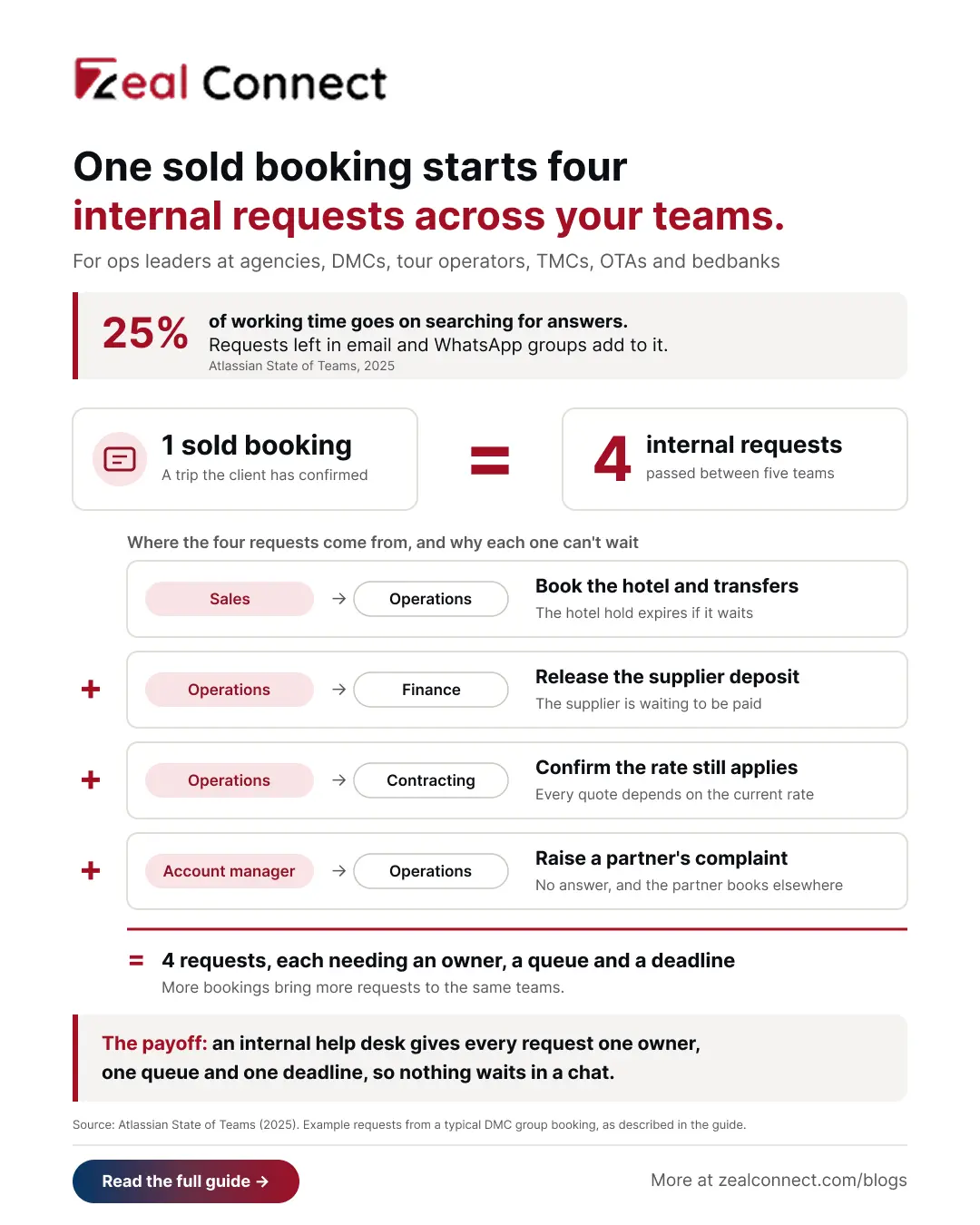
A single sold booking can start four or five internal requests. Sales asks operations to confirm the hotel and transfers. Operations asks finance to release a supplier deposit, then checks with contracting that a rate still applies. Later, an account manager raises a partner's complaint with ops. Because each booking adds requests, internal volume grows with sales, not with headcount. A season with 30% more bookings brings roughly 30% more internal requests to the same teams.
Every sold booking starts several internal requests, so internal communication in a travel company grows with bookings, not headcount.
Where do internal requests get lost today?
They get lost across channels. Grammarly's 2024 research with The Harris Poll found that knowledge workers spend 88% of their workweek communicating across multiple channels. Travel teams also juggle booking systems. A Sabre commissioned study found that more than 91% of travel agencies run four or more booking systems. So a request might sit in a WhatsApp group while the booking it refers to sits in another system. Atlassian's State of Teams 2025 found that leaders and teams lose 25% of their time just searching for answers.
What a lost internal request costs a travel company
An internal request that nobody owns doesn't fail loudly. It waits. A hotel hold expires because ops saw the booking request on Monday instead of Friday. Elsewhere, a refund promised to a client sits unprocessed because the message to finance went to someone on leave. And when a partner escalation gets no answer, that partner books elsewhere next time. Meanwhile, the traveler sees none of your teams, only one company that didn't deliver.
What Does an Internal Help Desk Do for a Travel Company?
It gives requests between your teams one place to live, with an owner, a status and a deadline. Most travel companies already have email, chat and a booking system. What they lack is a shared record of who asked for what, who owns it and when it's due.
Internal help desk software, defined
Internal help desk software is a ticketing tool for requests between teams inside a company. Each request becomes a ticket with an owner, a status, a deadline and a full history. Work then no longer depends on someone's inbox or memory. In a travel company, the busiest requesters are sales, reservations and account managers. The busiest receivers are operations, finance and contracting, while IT and HR use the same tool for their own requests.
The core functions of an internal help desk
Most help desks share the same core functions, and each one fixes a specific communication problem:
- Intake: requests arrive through a short form, an email address or a chat shortcut.
- Department queues: each request lands with the team that owns it, such as operations, finance or contracting.
- One owner and a status: someone accepts the request, and everyone can see its status.
- Internal notes: teams discuss the request on the ticket itself, so the conversation stays with the work.
- Booking link: the request attaches to the booking it's about, so the next person can find it.
- Internal knowledge base: answers that keep being asked get written down once.
- Reporting: you can see how long requests take and where they wait.
Internal help desk clocks: OLAs between teams
Customer tickets run on SLAs you promise travelers. Internal requests need a different promise, made by one team to another. Service management calls this an operational level agreement, the internal commitment that supports a customer SLA. For example, operations might accept a booking request within four business hours. Finance might process an approved refund within one working day. In travel, however, supplier deadlines can shorten that clock. When a hotel hold lapses on Sunday evening, four business hours is too slow. The request's deadline has to follow the booking.
An OLA is the promise one team makes to another, and in travel a supplier's deadline can shorten it.
Key Terms Worth Knowing
A few terms come up throughout this article on internal help desks in travel companies. Here is what each one means.
- Requester: The colleague who raises an internal request, such as a salesperson asking operations to book a group.
- Department queue: The list of open requests owned by one team, such as operations or finance, sorted by deadline and priority.
- Internal note: A comment written on the request itself and visible to colleagues, so the discussion stays with the work.
- Operational level agreement (OLA): An internal agreement on how fast one team responds to another.
- Internal knowledge base: Written answers, policies and how to guides for staff, so repeat questions get answered without interrupting a colleague.
Which Internal Messages Belong on the Help Desk, and Which Stay in Chat
An internal help desk works best when it takes over some internal communication and leaves the rest alone. That matters because teams already juggle too many places. A Gartner survey found that 47% of digital workers struggle to find the information they need. The average desk worker now uses 11 applications. A help desk should reduce the places a request can hide. The table below sorts common internal messages by where they belong.
Table: Which internal messages belong on the help desk, and which stay in chat
An internal ticketing system for requests, approvals and escalations
Three kinds of message need the help desk: requests for work, approvals and escalations. Each one asks another team to act, so it needs an owner, a deadline and a record. An approval such as a fee waiver also needs to show who decided and when, because finance and the client will ask later. Escalations need a priority that moves them up the queue. If any of these stay in chat, they depend on someone remembering to scroll back.
If someone has to act by a certain time, the message belongs on the help desk.
Chat for quick questions, the knowledge base for answers that repeat
Chat is still the right place for a question someone can answer in a minute. Every ping interrupts the person who receives it. Microsoft's 2023 Work Trend Index found that 68% of people don't have enough uninterrupted focus time during the workday. So watch which questions come up again and again. When the same question about name changes comes up three times in a month, write the answer once in the internal knowledge base.
One internal request walked end to end: a group booking from sales to operations
Here's an illustrative example of a common DMC request. Group files make a good test, because a group's rate, billing instructions and room list often sit in different places. Sales confirms a three night incentive for 36 guests after three weeks and 41 emails. Instead of forwarding the thread, sales opens a booking request ticket. A short form asks for the final quote version, guest names, special requests and the hotel option date.
Because the hold lapses on Sunday, the ticket goes to the top of the operations queue. Ops accepts it, or returns it with "names missing for 9 guests". When the hotel adds a surcharge, ops opens a linked request to sales for client approval. Flows like this still run by hand in many operations. In WeTravel's 2026 research, 41% of multiday operators name manual or time consuming processes as a top pressure for 2026 tours.
Setting Up Internal Help Desk Software Across Your Travel Teams
You own the outcome, so you set the rules. Your sales, finance and contracting heads need to agree to them. Your CTO will want to approve any link to the booking system. Start with the requests that cost the most when they go missing, then widen.
Start with the three requests that cross teams most often
In most travel companies, three internal requests carry the most risk. They are the booking handoff from sales to ops, refund and supplier payment requests from ops to finance, and partner escalations to ops. Build one short form for each, and make a field required only if the receiving team can't act without it. Then prefill whatever the booking system already knows, such as dates and the booking reference.
Give each department a queue, an owner and a response time
Set up one queue per receiving team, and agree a response time for each with that team's head. Operations might accept booking requests within four business hours, while finance processes approved refunds within one working day. Then add one override. Any request tied to an option date or ticketing time limit inside 48 hours goes to the top and reaches out of hours cover.
A returned request should name exactly what's missing, never just say "incomplete".
Which numbers show internal communication is improving?
Five numbers tell you. Track the share of internal requests still arriving by WhatsApp, email or direct message, which should fall each month. Measure the time from a request being raised to someone owning it. Count requests returned for missing details, since that shows whether the forms ask the right things. Watch how many requests pass their internal clock. Finally, count repeat questions moved into the knowledge base, because each one is an interruption you won't have again.
If your operations team runs on Zeal Desk, the same setup uses features it already has. Departments can act as queues with their own SLA, hours and assignment. Custom forms support required fields and per role edit rights. Parent and child tickets keep a booking and its related requests together. The integration hub pulls booking data onto the ticket, and multiple knowledge bases hold internal policies and SOPs.
Conclusion
Most communication between travel teams is one team asking another to act, and every booking adds more of it. Internal help desk software gives those requests a shared home: a form, a queue with one owner, and an agreed response time. Chat stays for quick questions, and the internal knowledge base takes the answers that keep coming back. Start with the three requests that cost the most when they go missing, and run them through the desk for a month. Then compare how many still arrive by WhatsApp, because that number shows whether your teams have moved.
Frequently Asked Questions
What is the difference between an internal help desk and a customer help desk?
An internal help desk handles requests from colleagues, while a customer help desk handles requests from travelers and trade partners. The tools work in similar ways, but the clocks differ. Internal requests run on operational level agreements between teams, and customer tickets run on SLAs you promise the client. Both should link to the same booking.
Does an internal help desk replace Slack, Teams or WhatsApp groups?
No. Chat stays for quick questions and conversation. The help desk takes over the messages that need an owner, a deadline or a record, such as booking requests, approvals and escalations. Most teams add one simple rule: if someone has to do something by a certain time, it goes on the desk.
Is an internal ticketing system worth it for a small travel company?
Yes, once requests pass between two people or two shifts. Even a DMC with ten staff can lose a hotel hold when a booking request waits in one inbox over a weekend. Start with one request form and one response time, then add more only when a real gap shows up.
Should IT and HR requests go on the same internal help desk?
They can. Most internal help desks handle IT, HR and operational requests in separate queues on one system, so staff learn one place to ask. In a travel company, though, start with the operational requests between sales, operations and finance, because those put bookings and money at risk.