


- Customer support in travel is harder than support in most industries, because the request often arrives while the traveler is mid journey, with money and safety on the line and volume coming in spikes.
- This article breaks the challenges and solutions into three windows, before, during, and after a trip, and gives you a Trip Timeline Support Map to plan around.
- Written for support and operations leaders at any travel company, it ends with the solutions that move real metrics rather than generic tips.
A booking problem in retail can wait until morning. A travel problem usually cannot. The customer is often standing at a gate, a closed hotel desk, or a rental counter when something goes wrong, and they need an answer now. That single fact shapes everything about customer support in travel. The work really splits into three jobs, and each one changes depending on when in the trip the request arrives. This article walks through the challenges and the solutions window by window, so you can see where your own operation strains and what actually fixes it.
Customer Support in Travel Carries Time and Money Stakes Most Industries Never Face
Support teams in most sectors measure success in hours or days. Travel rarely gives you that room. A missed answer can mean a missed flight, a night without a room, or a payment stuck in limbo. On top of the pressure per contact, the work arrives unevenly, and the industry behind it is enormous. That backdrop explains why a support playbook built for a software company falls short here.
Why Is Customer Support in Travel Tested While the Customer Is Already on the Move?
The traveler is usually in motion when the problem lands. A delayed connection, a no show transfer, or a card declined at check in all happen away from home, often abroad, and often outside office hours. So the stakes feel personal and immediate. A late reply to a software ticket is an annoyance, but a late reply to a stranded traveler can ruin the trip and cost you the customer. That urgency is the baseline every travel support team works against, and it never really eases.
Disruption Turns Travel Customer Support Into Spike Management
Volume in travel does not arrive in a steady stream. Instead, it clusters around disruption. Weather, strikes, and system outages can multiply contacts within hours, and disruption is common rather than rare. In 2024, only 72.4% of European flights arrived within 15 minutes of schedule, up slightly from 70.6% the year before, according to EUROCONTROL (2025). That means more than one flight in four ran late. Every one of those delays pushes travelers to seek help at the same moment, which is why staffing to an average guarantees failure on the days that matter most.
In travel, support volume follows disruption rather than a smooth daily curve, so plan for the spike instead of the average.
How Large Is the Support Load Travel Companies Actually Carry?
The load is bigger than teams outside the sector usually assume. Travel and tourism contributed a record US$11.6 trillion to the global economy in 2025 and supported 366 million jobs, according to WTTC (2026). Behind that scale sits a customer who now expects help at any hour, in any channel, and in their own language. That mix of high volume and round the clock expectation is more than a generic contact center model was designed to hold.
What Customer Support in Travel Involves: The Three Windows of the Trip
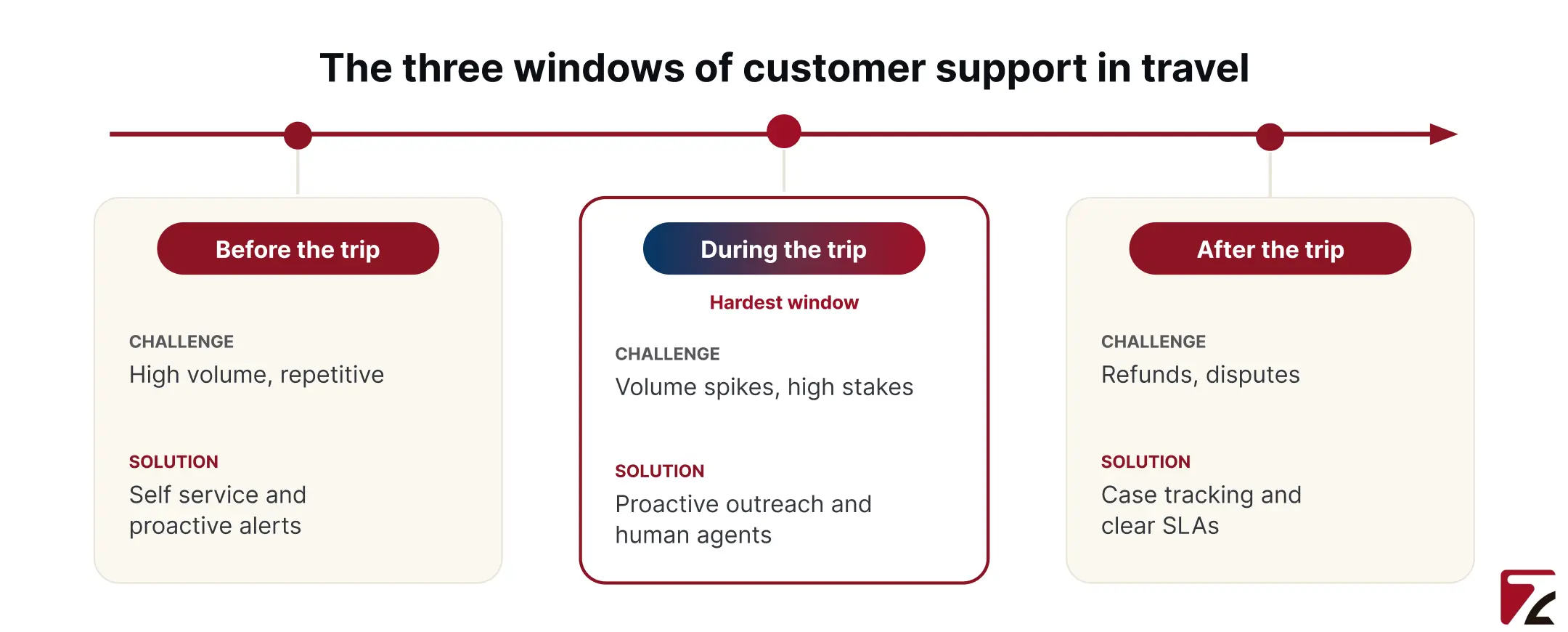
Customer support in travel is the work of helping a traveler before, during, and after a trip: answering questions, changing bookings, and resolving problems across phone, email, chat, and messaging, usually under a live clock, for any travel company from an OTA to a tour operator or DMC. What makes it distinct is that these three windows are not variations of one job. They differ in urgency, channel, emotion, and the kind of decision an agent has to make. Treating them as a single queue is where most support operations start to strain.
Support Before the Trip: Booking Questions, Changes, and Setting Expectations
Before departure, most requests are predictable. Travelers ask about baggage rules, visa documents, seat changes, or payment confirmations. The volume can run high, yet the questions repeat and the answers are known in advance. Time pressure is lower too, because the traveler is still at home with options. This is the window where good self service tools and clear proactive messaging remove the most work, since a well timed confirmation email stops a call before it starts.
Support During the Trip: The Live, High Stakes Window That Defines Travel
Once the trip begins, support changes character completely. The traveler is mobile, often stressed, and working against a clock they cannot pause. A single delay can cascade into a missed connection and a lost night. Disruption at this stage is widespread: 89% of business travelers were affected by travel disruption in 2025, the highest figure in three years, and two thirds reported higher stress as a result (Perk, 2025). This is the window that makes travel support hard, and the one a generic help desk handles worst.
Support during the trip, especially during disruption, is what makes customer support in travel harder than support in any other industry.
Support After the Trip: Refunds, Complaints, and Recovery
After the trip, the work shifts to money and resolution. Refund requests, service complaints, chargebacks, and compensation claims all land here. These cases are more structured than emergencies during the trip, but they carry financial and reputational weight, and many are disputable. A slow or unclear process afterward erodes loyalty and shows up in public reviews. Handled well, however, the same window becomes a chance to recover a shaky trip and keep the customer.
Table: The Trip Timeline Support Map, challenges and solutions by trip stage
| Trip stage | What the traveler needs | Why it is hard for support | Cost of getting it wrong | The solution that fits |
|---|---|---|---|---|
| Before the trip | Booking, changes, docs | High volume, repetitive | Churn before departure | Self service and proactive confirmations |
| During the trip (routine) | Quick answers on the move | Mobile, time boxed, multichannel | A small issue ruins the day | Omnichannel and fast first response |
| During the trip (disruption) | Rebooking, reassurance | Volume spikes, high emotion | Reputation, refunds, safety | Proactive outreach and human agents |
| After the trip | Refunds, dispute resolution | Structured but disputable | Chargebacks, lost loyalty | Case tracking and clear SLAs |
Key Terms Worth Knowing
A few terms come up throughout this article on customer support in travel. Here is what each one means.
- Deflection rate: the share of contacts a traveler resolves through self service, without ever reaching an agent.
- First response time (FRT) and average handle time (AHT): the two clocks a travel desk lives by, how fast you reply and how long each case takes.
- Omnichannel support: one connected view of a traveler across phone, email, chat, WhatsApp, and OTA messaging, so context is not lost between channels.
- Proactive support: reaching the traveler with information, such as a delay alert or a rebooking option, before they contact you.
- Warm handoff: passing an automated or self service conversation to a human agent with the full history and booking details attached.
How Do Customer Support Challenges in Travel Differ Across the Industry?
The three windows apply to every travel company, yet they do not weigh the same everywhere. An online travel agency and a destination management company face very different pressures, even when both call it customer support. Knowing which window dominates your business is what tells you where to invest first. Here is how the challenges concentrate across the main types of travel operation.
Which Customer Support Challenges Hit OTAs and Airlines Hardest?
High volume sellers feel the most pressure during and after the trip. OTAs and airlines handle enormous booking counts, so disruption reaches them at scale and refunds pile up afterward. The trend is not improving either: European flight cancellations rose to 2.2% in 2023 from 1.7% a year earlier, and in North America 2.1% of passengers faced delays over three hours, according to AirHelp (2025). For these companies, the core challenge is absorbing sudden spikes without letting first response times collapse. You can read more on automating high volume travel tickets in a dedicated guide.
For Tour Operators, DMCs, and TMCs, the Hard Part Is Supplier Coordination
For itinerary based businesses, volume is rarely the problem. Their challenge is coordination. A single request often means chasing a hotel, a local guide, and a transfer company before the traveler can get an answer. So the agent is not the bottleneck; supplier response time is. Resolution latency, rather than first response, is the metric that hurts here. Tour operators, DMCs, and TMCs need support systems that track multi supplier cases and keep every party visible on one thread.
Travel Payment Firms Live Mostly in the Window After the Trip
Payment and fintech players in travel see support concentrate after the transaction. Chargebacks, settlement disputes, and fraud reviews dominate their queues, and each carries compliance weight. Because these cases are structured and evidence heavy, they suit clear workflows and careful case tracking. The risk is treating a financial dispute like a routine question. A payment problem needs an audit trail, defined SLAs, and a specialist who understands settlement, not a generic first line reply.
Customer Support Solutions in Travel That Actually Move the Numbers
Knowing where support breaks is only half the job. The other half is choosing solutions that move the metrics you are measured on: first response time, deflection, cost per contact, and resolution within SLA. The strongest solutions map directly to the trip timeline. Three matter most, and they work together rather than in isolation.
Proactive Support Is the Highest Leverage Customer Support Solution in Travel
The most effective way to handle a spike is to prevent the contact. Proactive support means reaching travelers first, with a delay alert, a rebooking link, or a status update, before they call. It reduces inbound volume, which is the one lever an ops leader controls without hiring. Reducing call volume ranks among the top priorities for customer care leaders, McKinsey has found, and proactive outreach is one of the few moves that does it at the source. During disruption, a single proactive message can replace hundreds of inbound calls. This is the core of proactive customer service done well.
Which Travel Customer Support Tasks Should Be Automated, and Which Stay Human?
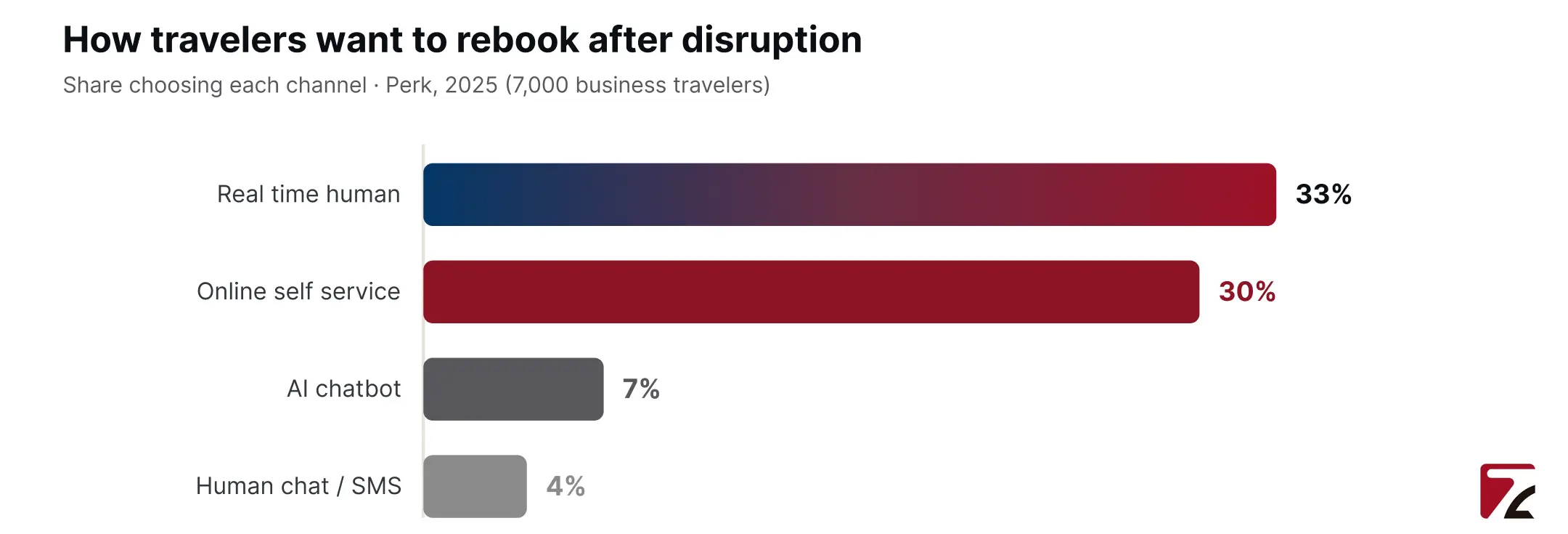
Automate the predictable, and keep people on the judgment calls. Questions before a trip, status checks, and document requests are repetitive and safe to handle with self service or automation. Money movement, live disruption, and anything needing empathy should stay with a person. Travelers agree: when rebooking after disruption, 33% still prefer real time human contact and only 7% prefer an AI chatbot (Perk, 2025). Independent research points the same way, with Phocuswright documenting renewed reliance on human advisors for complex trips. Automation still helps; the point is to apply it to the right layer, so agents are free for the moments that decide whether a customer returns.
Automate the predictable questions before a trip, and keep human agents for live disruption and decisions that move money.
Software, Services, and Self Service: Building the Support Stack Around the Timeline
The tools should follow the timeline. Good customer support software in travel gives agents one omnichannel view and booking aware context, so a case does not restart every time the channel changes. Self service handles the repetitive layer before a trip, though it has a ceiling: it cannot move money or rebook a stranded traveler, so it must hand off cleanly with full context. Travel customer support services, meaning outsourced teams, fit best for seasonal peaks and 24/7 multilingual coverage, while complex disruption and loyalty cases stay with specialists. With always on now the norm and 74% of consumers expecting 24/7 service per Zendesk's CX Trends 2026, the aim is a stack where each window is covered by the method that fits it.
Conclusion
Customer support in travel is really three separate jobs under one name. The window before the trip rewards good self service and proactive messaging. The window during the trip, especially during disruption, is where the operation is truly tested and where human agents earn their place. The window after the trip turns on clear workflows and honest SLAs. If you can only fix one thing first, fix support during the trip, because that is where a small failure becomes a lost customer. Map your own contacts to the three stages, match each to the solution that fits, and measure the result in first response time, deflection, and resolution within SLA. The timeline is the plan.
Frequently Asked Questions
Why is customer support in travel harder than in other industries?
Because the request usually arrives while the traveler is already on the move, with money, time, and sometimes safety on the line. Volume also spikes during disruption instead of arriving steadily. That mix of urgency and unpredictability makes travel support far less forgiving than retail or software support.
Do travelers still prefer human support, or is a chatbot enough now?
Both have a place. Automation handles routine, plannable questions well. For disruption and complex changes, most travelers still want a person. The practical rule is to automate the routine layer and keep human agents for high stakes, judgment heavy moments, so people are available exactly when a trip is on the line.
What should travel companies look for in customer support software in travel?
Look for one omnichannel inbox, booking aware context so agents see the reservation, and automation for the repetitive layer before a trip. Just as important is a clean warm handoff from self service to a human, so a stranded traveler never has to repeat their story to get real help.
When do outsourced travel customer support services make sense?
Outsourced services fit best for predictable pressures: seasonal peaks, overnight coverage, and multilingual demand you cannot staff in house. Keep complex disruption handling, loyalty escalations, and financial disputes with specialists who know your product. Used this way, outsourcing adds flexible capacity without diluting the quality of your hardest cases.
Which metrics matter most for customer support in travel?
Track first response time and average handle time for speed, deflection rate for self service effectiveness, and cost per contact for efficiency. Most useful of all is resolution within SLA measured by trip stage, since a breach during the trip costs far more than a slow reply before it. CSAT alone hides these differences.