


- Multi language customer support in travel is the work of serving travelers in the languages they book, travel, and complain in, without hiring a native agent for every language.
- This article gives you a working definition, a demand and stakes decision matrix that routes each language and interaction to the right delivery model, the high stakes interactions where machine translation is unsafe, and how to run 24/7 coverage across time zones.
- Written for support and CX leaders at OTAs, DMCs, and TMCs running cross border volume.
Every day, travelers book, complain, and ask for help in languages your team may not staff. A German family disputes a refund. A Japanese business traveler needs rebooking after a cancellation. You cannot hire a native agent for every language, and machine translation is not safe for every conversation. So the real question in customer support in travel is not whether to go multilingual. It is which language gets which kind of support, and this article gives you a way to decide.
Multi Language Customer Support in Travel Is Now an Operational Requirement, Not a Nice to Have
International travel runs on many languages at once. A traveler from São Paulo, a supplier in Bangkok, and an airline in Frankfurt can all touch the same booking. When something goes wrong, they contact you in their own language, on their own schedule. For a Head of Support, that turns language from a marketing preference into a staffing, quality, and cost problem you own. The figures below explain why it can no longer sit on a wish list.
Why does language decide whether customer support in travel works at all?
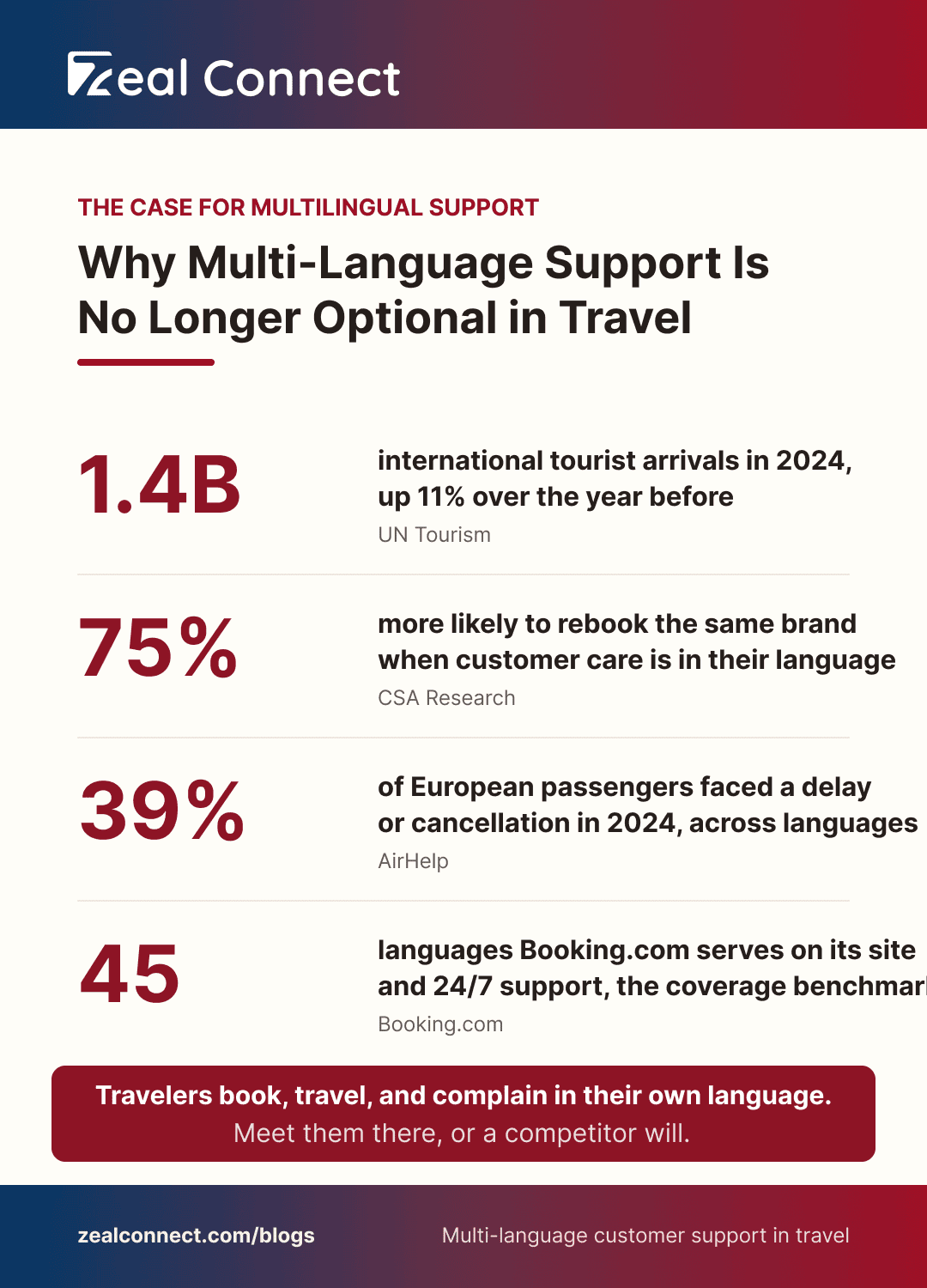
A traveler who cannot get help in their own language often leaves. Language is an access issue before it is a courtesy. According to CSA Research (2020), 75% of consumers are more likely to buy the same brand again when customer care is offered in their language. In travel, where repeat bookings and reviews drive growth, that loyalty gap is real money. Support in the traveler's language protects a relationship you already paid to win.
In travel, language is an access issue before it is a courtesy, and 75% of consumers say they will repurchase when support comes in their own.
International travel volume makes multi language support unavoidable
Cross border travel is at record scale, so non native language contacts are now routine rather than rare. UN Tourism (2025) recorded an estimated 1.4 billion international tourist arrivals in 2024, up 11% over 2023. Every one of those trips can generate a question, a change, or a complaint, often in a language other than English. A support operation built for one or two languages will therefore miss a growing share of its own customers. Planning coverage around real traveler origins has become table stakes.
Disruption spikes flood many customer support in travel queues at once
Daily volume is manageable; concurrency is the hard part. When a storm or an IT outage grounds flights, contacts surge across many languages within the same hour. In Europe, AirHelp (2024) reports that 110 million of 285 million passengers, about 39%, faced a delay or cancellation in 2024. A single event can flood your German, Spanish, and Mandarin queues together. Coverage has to hold up under simultaneous pressure, not just daily averages.
What Is Multi Language Customer Support in Travel, and How Do You Decide Coverage?
Multi language customer support is less about tools and more about decisions. You have a fixed budget, a long list of languages, and interactions that range from a baggage FAQ to a medical emergency abroad. Treating them all the same wastes money on the routine and takes risks on the serious. The section below defines the term plainly. Then it gives you a simple way to route each language and interaction to the right support.
Multi language customer support in travel, defined
Multi language customer support in travel is the practice of serving travelers in the languages they book, travel, and complain in, across phone, email, chat, and messaging, without dropping response speed or answer quality. It combines native speaker agents, AI assisted agents, and machine translation, matched to the value and risk of each interaction. Scale shows what full coverage can look like: Booking.com runs its website and 24/7 customer service in 45 languages, according to Booking.com. Most operators cannot match that, which is exactly why coverage has to be a deliberate choice.
A coverage decision matrix for customer support in travel
Two questions decide how to support any interaction: how much demand exists for that language, and how high the stakes are if the answer is wrong. Plot those two together and four sensible models appear. High volume routine questions can run on self service and machine translation. High stakes conversations in a major language justify native agents. The table below turns that into a working rule you can screenshot and apply.
Table: Matching language demand and interaction stakes to the right support model
| Language demand × interaction stakes | What it looks like in travel | Right delivery model | Why a cheaper model fails here |
|---|---|---|---|
| High demand · low stakes | Booking status, baggage FAQ, top language | Self service plus AI assisted agent | Native hire is overspend for routine queries |
| High demand · high stakes | Refund dispute, disruption rebooking | Native speaker agents or language pod | Machine translation risks a costly fare rule error |
| Low demand · low stakes | Routine query, long tail language | AI assisted monolingual agent plus MT | Volume cannot justify a full time native hire |
| Low demand · high stakes | Safety, medical, or visa issue, rare language | Vetted human interpreter or escalation | MT can produce a fluent, undetectable error |
Multi language customer support in travel is a coverage decision, not a translation purchase you switch on.
The four delivery models behind multi language customer support in travel
Each quadrant maps to one of four ways to deliver support. Self service and machine translation handle routine, low risk questions the traveler can settle alone. AI assisted monolingual agents work in one language while software drafts and translates a reply the agent reviews and sends. Native speaker agents own the high stakes, high volume languages. For rare languages in serious situations, a vetted human interpreter steps in. Industry guides describe a similar spread of delivery models, from native agents to automation. Appetite for the assisted model is real: Zendesk (2025) found 67% of consumers ready to delegate routine tasks to AI. A person still sends every customer reply.
Key Terms Worth Knowing
A few terms come up throughout this article on customer support in travel. Here is what each one means.
- Localization versus translation: translation converts words from one language to another, while localization adapts dates, currency, tone, and examples so the message fits the traveler's culture.
- Machine translation (MT): automated translation by software, often neural MT. It is fast and cheap, but uneven on nuance and the exact wording that fare rules and legal terms depend on.
- Language pair: the source and target combination, such as English to Portuguese. MT quality and agent availability vary widely by pair, so some languages are far harder to serve.
- Follow the sun: a staffing model that routes support across regional teams in different time zones, so cases are handled during someone's local daytime instead of overnight shifts.
- Language penalty: the gap in first response time, satisfaction, or resolution that non English travelers get compared with English speaking ones, usually hidden inside blended reporting.
Which Customer Support in Travel Interactions Must Never Rely on Machine Translation?
Machine translation has a place, but not everywhere. Some conversations carry money, safety, or legal weight. A translation that reads fluently can still be wrong, and no one catches it until it is too late. Drawing that line is the most important call in a multilingual operation. This section names the interactions that need a human who speaks the language, and the metric that tells you whether your language coverage is working.
The high stakes carve out in customer support in travel: refunds, disruption, safety, and legal
Four kinds of interaction should never run on raw machine translation. Refund and fare rule disputes turn on exact wording, so a mistranslated condition can cost you money. Disruption rebooking involves times, dates, and options, where an error can strand someone. Safety and medical issues abroad carry real world consequences. Visa and legal questions can create liability. Travelers already lean on machine tools, since CSA Research (2020) found 66% use online machine translation, which means they may not spot an error either. For these, route to a native speaker.
A fluent mistranslation is the most expensive failure in multilingual travel support, because no one notices it until the money or the safety is already gone.
How to measure the language penalty in your customer support in travel
You cannot manage what you report as one blended number. Track first response time, satisfaction, and resolution rate by language, not just overall. When one language sits well below the rest, that is a coverage or training signal rather than random noise. OTAs often see it in refund queues, DMCs in on trip incidents, and TMCs in after hours corporate support. Watching these splits shows where to add a native agent, better machine translation, or a glossary before complaints climb.
How to Build Multi Language Customer Support in Travel That Holds Up 24/7
A good decision matrix still needs an operating model behind it. Travelers move across time zones, so support has to be awake when they are, in the language they need. Building that means three things: coverage that follows the clock, a clear split between what you keep in house and what you send out, and consistency so every language queue gives the same answer. Here is how those pieces fit together.
Follow the sun coverage puts the right language and a live agent together
The cleanest way to run 24/7 support is to route work across regional teams as the day moves. A follow the sun model places teams in the Americas, EMEA, and Asia Pacific, each working local daytime hours. Done well, a live agent and the right language arrive together, instead of a traveler waiting for one office to wake up. Clear handoff notes between regions keep an open case moving, which matters most during the disruption spikes that hit many languages at once.
Should you keep multi language customer support in travel in house or outsource it?
Decide it per language tier, not as one all or nothing choice. Keep your high stakes, high volume languages in house, where you control quality and product knowledge. Send overflow and long tail languages to a partner or an AI assisted model, where flexibility matters more than deep expertise. Most page one advice pushes a single answer, usually to outsource everything. A blended model fits travel better, because your risk sits in a few languages and a few interaction types.
Match the delivery method to the tier, not the whole operation to one vendor.
Keep answers consistent across every language
Ten language queues can quietly give ten different answers to the same question. A shared glossary of travel terms, such as fare rules, no show, and reaccommodation, keeps wording accurate in every language. A short brand voice guide keeps the tone steady. Per language quality checks catch drift early, so your Spanish team and your German team apply the same refund rule the same way. Consistency is what makes multilingual support feel like one operation rather than several stitched together.
Conclusion
Language is not a feature you switch on; it is a set of decisions you make on purpose. Start by mapping your real traveler languages against demand and stakes. Then route each one to the model that fits. Use self service and machine translation for the routine, and native speakers for anything that carries money, safety, or legal weight. Protect the high stakes carve out, because a fluent mistranslation is the failure that costs the most. Build coverage that follows the clock, decide in house versus outsourced by language tier, and hold every queue to the same glossary. Then measure first response, satisfaction, and resolution by language, so you can see whether non English travelers get the service you promise. That visibility is where better multi language customer support in travel begins.
Frequently Asked Questions
How do I decide which languages to support first?
Start with demand and risk, not a wish list. Rank languages by their share of bookings, contact volume, and disruption exposure, then weigh the revenue at stake if service slips. Fund native coverage for your top few high stakes languages first, and use AI assisted models for the long tail.
Where is machine translation safe in travel support, and where is it risky?
Machine translation is safe for routine, low stakes questions, such as booking status, baggage rules, or opening hours, where a small error is easy to catch. It is risky for refunds, disruption rebooking, safety, medical, and legal issues, where a fluent but wrong translation can cost money or create liability. Route those to a native speaker.
Do I need native speakers, or can AI assisted agents cover other languages?
You need both, split by stakes. AI assisted monolingual agents, where software drafts and translates a reply the agent sends, handle routine questions well across many languages. High stakes interactions, meaning anything involving money, safety, or law, should go to a native speaker who can judge nuance and own the wording.
How do I provide 24/7 support in multiple languages across time zones?
Use a follow the sun model. Place teams in the Americas, EMEA, and Asia Pacific so each works local daytime hours, then hand open cases between regions with clear notes. This keeps a live agent and the right language available around the clock, without asking anyone to work permanent night shifts.
What should I measure to know if non English travelers get worse service?
Track first response time, customer satisfaction, and resolution rate broken out by language, not blended together. A language that consistently scores below the rest signals a coverage or training gap. Watching these splits shows you where to add a native agent, improve machine translation, or tighten your glossary.