


This article explains how to grow customer support in travel when contacts keep rising and spike every peak season, without hiring in step with the volume.
You will get a plain capacity equation, a worked peak week budget showing how a flat team absorbs a 3x spike, the levers that add capacity and where each one stops in travel, a deployment sequence, and the honest signal that it is finally time to add people.
It is written for support and operations leaders who own SLA, cost, and team productivity.
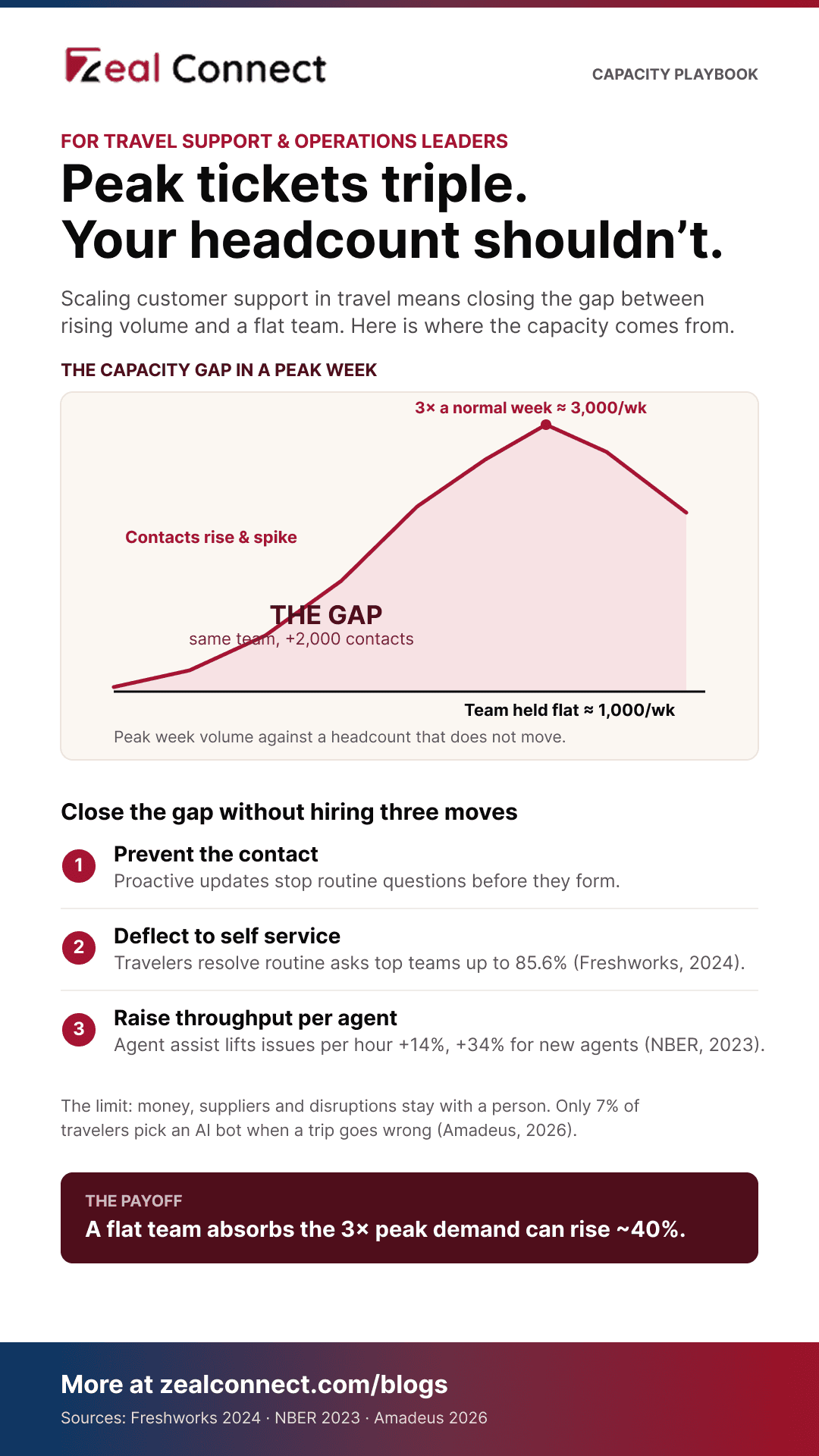
Every company running customer support in travel faces the same squeeze. Contacts climb a little every year, then triple in peak season, but the budget for agents rarely moves the same way. Hiring to match the curve is slow and costly, and the extra people sit idle once the rush passes. So the real question is not how many agents to add. Instead, it is how to make the team you already have absorb far more volume. That starts by treating capacity as a number you can move, not a headcount you must match.
Why Hiring Can't Keep Up With Customer Support in Travel
Support demand in travel grows two ways at once, and both defeat straight line hiring. The first is a slow structural climb as more people travel each year. The second is the seasonal spike, when a few weeks carry several times the normal load. A team sized for the average drowns in July. A team sized for July wastes money in November. Neither fits, which is why hiring alone never keeps pace.
Travel Demand Keeps Rising, So the Support Baseline Never Resets
The quiet season keeps getting louder. Global air travel set records again last year. According to IATA (2025), full year 2024 passenger traffic rose 10.4% over 2023, with a record 83.5% load factor. More passengers means more bookings, more changes, and more questions, so your baseline volume trends up before any peak arrives. A desk that felt comfortable two years ago already handles more today. Hiring to last year's normal leaves you behind this year's.
Seasonal Spikes, Not the Average Week, Decide Your Support Headcount
Peaks are where staffing plans break. Disruption clusters hard in summer, and the numbers are stark: Hopper (2024) found travel disruption rates rose 57% between May and July, while 27% of US flights were delayed or canceled on departure in July alone. Every delay, cancellation, and missed connection becomes a wave of urgent contacts inside the same short window. Your team does not need to survive the average week. Instead, it needs to survive the worst one, and that worst week is what sets how many agents you think you need.
In travel, the worst week sets your headcount, not the average one.
Can You Just Hire Your Way Through the Peak?
Not cleanly. Hiring takes weeks to source and more weeks to train, and the labor market for customer service roles stays tight, so a spike that lands in June needs people you started recruiting in spring. Once the peak fades, that headcount has little to do. Most urgent travel contacts also cannot wait in a queue while a new hire ramps up. Seasonal and temp staff help, yet they carry a training cost and a quality risk. Permanent hiring sized to the peak is the wrong tool for a load that lasts a few weeks.
What Does It Mean to Scale Customer Support in Travel Without Adding Headcount?
Scaling customer support in travel without adding headcount means handling more contacts without growing the team in step with them. You move two numbers instead: the share of contacts that reach a human, and how many each agent clears per shift. Capacity becomes a ratio you manage, not a roster you expand. That reframing is the whole game, so it helps to make the math explicit.
agents needed = contacts that reach a human ÷ throughput per agent
Move either number and capacity changes without touching the roster
Support Capacity Is a Ratio, Not a Team Size
Here is the equation underneath everything. The number of agents you need equals the contacts that reach a human divided by how many each agent handles. Two levers fall out of that fraction. Shrink the top number by keeping contacts away from agents. Grow the bottom number by helping each agent work faster. Move both together, and demand can climb 40% while required headcount stays flat. That is what scaling without adding headcount actually means in practice.
Capacity is a ratio, so demand can rise without headcount rising, as long as you move the two numbers inside it.
The Two Ways to Add Support Capacity Without Hiring
Every real tactic is one of those two levers, so it pays to name them plainly. The first lever removes contacts before they reach a person. Proactive updates stop some from forming, and self service resolves others, which matters because HubSpot (2024) found 78% of CRM leaders say customers prefer to solve issues on their own. The second lever raises throughput. Give agents help desk automation that cuts handling time so each clears more. Most teams need both, since either one alone tops out quickly.
Deflection Is Not the Same as Resolution
A deflected contact still has to end somewhere. Deflection means a contact never reached an agent, usually because the traveler found the answer alone. That only counts if the issue is genuinely handled. If the help center is vague, the traveler comes back angrier and you have added a step. So the goal is not a high deflection number on a dashboard. Instead, it is the set of contacts travelers can actually finish themselves, which is smaller and more specific. Keep that distinction, because it decides which contacts you can safely move off the team.
Key Terms Worth Knowing
Deflection rate: the share of support contacts resolved without an agent, usually because the traveler found the answer through self service. It counts only when the issue is genuinely handled.
Tickets per agent (throughput): how many contacts one agent clears in a set period, such as a shift or an hour. Raising it adds capacity without adding people.
Proactive support: reaching travelers with information before they contact you, such as a delay alert or a rebooking link, so the contact never needs to form.
Agent assist (copilot): AI that helps an agent by summarizing threads, surfacing booking details, and drafting replies. The agent reviews, edits, and sends, and the AI does not send on its own.
Peak to average ratio: how many times your normal weekly volume a peak week reaches. A desk at 1,000 contacts that hits 3,000 has a peak to average ratio of three.
How Customer Support in Travel Absorbs a Peak Spike Without Hiring More Agents
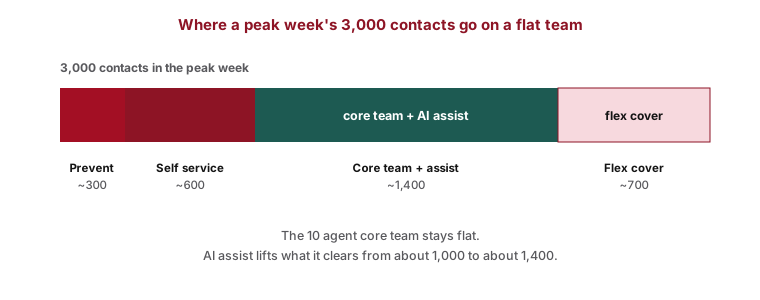
Put the two levers under a real spike, and you can see how far they carry you. Picture a mid size travel desk that handles about 1,000 contacts in a normal week with 10 agents. Peak season arrives and volume climbs to 3,000. The goal is to clear that week at the same SLA without hiring. The budget below shows where the extra 2,000 contacts go.
A Peak Week Capacity Budget for a Travel Support Desk
No single lever absorbs a 3x week. The load gets split across all of them. Proactive updates stop a slice of contacts from forming. Self service takes another slice that travelers can finish alone. Agent assist lets the same ten people clear more of what remains, and top performers show how much room there is. Across 17,170 businesses, Freshworks (2024) found leading teams deflected 85.60% of contacts by chatbot and cut resolution time 38.70% with an AI copilot. What is left is the hard core the team still owns.
Table: A peak week capacity budget, how a flat team absorbs a 3x spike (illustrative)
| Capacity source | What it does to the queue | Peak week contacts removed or absorbed | Where it stops in travel |
|---|---|---|---|
| Proactive updates | prevents contacts forming | about 300 never form | non standard changes |
| Self service | travelers resolve routine asks | about 600 handled agent free | supplier and money asks |
| AI assist | same agents clear more | 10 agents clear about 40% more | judgment or authority needed |
| Deterministic input automation | classify, route, extract, tag | cuts triage and handle time | ambiguous, multi supplier cases |
| Flex cover | defer, tier, add short cover | reshapes when humans work | everything urgent at once |
The core permanent team stays flat at 10 agents and owns the complex, high stakes, supplier dependent remainder. Shares are illustrative, built from cited deflection (top performers near 85%) and productivity (14 to 34% gains) ranges, and your own mix depends on ticket type.
Where Does Deflection Stop in Travel?
It stops the moment money or a supplier is involved. Confirming an itinerary or resending a voucher is easy to self serve. Reissuing a ticket after a cancellation, chasing a hotel, or processing a refund is not, because each needs judgment, authority, or a third party. Travelers know the difference too. Amadeus (2026) found that when a trip goes wrong, 37% of US travelers want phone support and only 7% choose an AI bot, even though 74% used AI to plan the trip. Those disruption contacts are exactly the ones you keep staffed.
Deflection ends where money, a supplier, or a disruption begins.
How the Support Mix Shifts Across OTAs, Tour Operators, and TMCs
The same budget shifts by who you are. An OTA sees mostly high volume, repeatable asks, so its biggest gains come from self service and deflection. A DMC or tour operator carries supplier dependent work, where much of the load is chasing hotels and ground agents, so agent assist and workflow automation matter more than a public help center. A TMC lives on disruption and reaccommodation, so it protects agent capacity for the urgent core and prevents what it can with proactive alerts. Read the budget through your own ticket mix before you copy anyone's ratios.
A Sequence for Scaling Customer Support in Travel Without Hiring
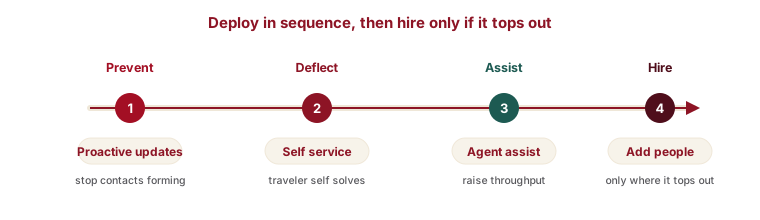
Knowing the levers is not the same as deploying them in the right order. AI in the contact center is no longer experimental. Calabrio (2025) reports that 98% of contact centers already use it in some form, so the tools are proven and available. What separates a smooth quarter from a stalled one is sequence. Do the cheap, contact removing work first, then raise throughput, and keep an honest line for when people are still the answer.
Start by Preventing and Deflecting Predictable Travel Contacts
Begin with the contacts you can remove for the least effort. Proactive messaging comes first, because a flight status push or a rebooking link sent before the traveler calls stops a contact from ever forming. The idea behind proactive support is to answer the predictable question before it is asked. Next, build or clean the help center so routine asks resolve without an agent. These two moves cost little and take pressure off every downstream step. Sequence them ahead of anything you buy, since they shrink the queue your other tools then have to handle.
Then Raise Agent Throughput on the Tickets That Remain
Whatever survives deflection lands on an agent, so make that agent faster. Assist tools summarize a long supplier thread, pull the booking into view, and draft a first reply for the agent to edit and send. The gain is measurable. Studying 5,179 agents, NBER (2023) found a generative AI assistant raised issues resolved per hour by 14% on average and 34% for newer agents. The payback is well established too, since Zendesk (2026) reports 90% of CX leaders see positive ROI on AI tools for their agents. Newer hires ramping faster also eases the hiring pressure you started with.
When Is Adding Headcount Still the Right Call?
Sometimes the honest answer is to hire, and saying so builds trust. Three signals point that way. First, deflection and assist have topped out and the remaining contacts genuinely need a person. Second, your baseline has shifted up for good, not just for a season, so the extra load is permanent. Third, the core team is running hot and quality is slipping. When disruption work climbs, remember that travelers still prefer a human for the hard moments. Scaling without headcount is a target for the routine load, not a rule that survives every situation. Add people where judgment and care are the product.
Sequence the levers by removing contacts first and raising throughput second, then hire only where judgment and care are the product.
Conclusion
Support volume in travel will keep rising and keep spiking, and no realistic hiring plan matches that shape. The way out is to stop matching it. Treat capacity as a ratio, the contacts that reach a human divided by how much each agent clears. Move the first number down with proactive updates and self service, move the second up with agent assist, and a flat team can absorb a peak that would otherwise force a hiring round. Draw the honest line where money, suppliers, and disruption demand a person. Start this week by measuring two things, how many times your baseline your peak week reaches, and which contact types travelers could finish on their own. Those two numbers point to your first gains.
Frequently Asked Questions
How much of a seasonal spike can I absorb without hiring?
Usually a large share of the routine volume, but not the complex remainder. Proactive updates and self service can remove many predictable contacts, and agent assist stretches the team further. What stays is the supplier dependent, money related, and disruption work, which still needs people. Model your own mix before promising a number.
What's a realistic deflection rate for travel support specifically?
It varies widely by contact type, so treat single figures with care. Structured asks like itinerary confirmations deflect high, while disputes and disruptions deflect low. Top performers across industries reach into the 80s, but travel's supplier and refund tickets pull the blended rate down. Expect a range, not one headline number.
Which travel tickets should never be deflected?
Anything involving money movement, a supplier, or traveler safety. Refunds, ticket reissues, chargebacks, rebooking after a cancellation, and any urgent on trip problem need human judgment and authority. A bot can gather details and hand over a clean summary, but a person should own the decision and send the reply.
Is outsourcing the same as scaling without headcount?
No. Outsourcing moves the work to someone else's team, so it is still headcount, just off your payroll. It can flex capacity for a season, which is useful. However, it does not change the underlying ratio the way deflection and agent assist do, and it adds coordination and quality overhead.