




This article sorts the AI tools for customer service in travel into five categories you can recognize, and gives each an honest read on what it delivers in a travel operation versus what it is sold as. It is written for operations and support leaders at OTAs, DMCs, wholesalers, and TMCs who choose the tools and defend the spend. You will get a working definition, a five category map, a sold as versus delivers comparison table, and a deploy first, keep human decision, without the demo hype.
You have probably sat through the demo. The AI answers a sample question in three languages, quotes a refund policy, and the vendor mentions a resolution rate somewhere north of 80%. Then you run a pilot, and it stalls on the first real ticket that involves a supplier and a booking reference. The gap between the demo and the desk is where most buying decisions go wrong. So the useful question is not which tool is newest. It is which of the AI tools for customer service in travel actually work in your operation, and why the ones that work tend to be the least glamorous.
AI Tools for Customer Service in Travel Are Oversold, and the Gap Has a Cost
Most AI tools in this category are sold on a number that flatters them and skips the part that matters. The pitch leans on deflection and a clean demo, while the thing you actually need, a solved problem on a messy travel ticket, lands lower and later. That gap has a cost, because you staff, budget, and set SLAs against the promise, then miss against reality.
What deflection hides that resolution reveals
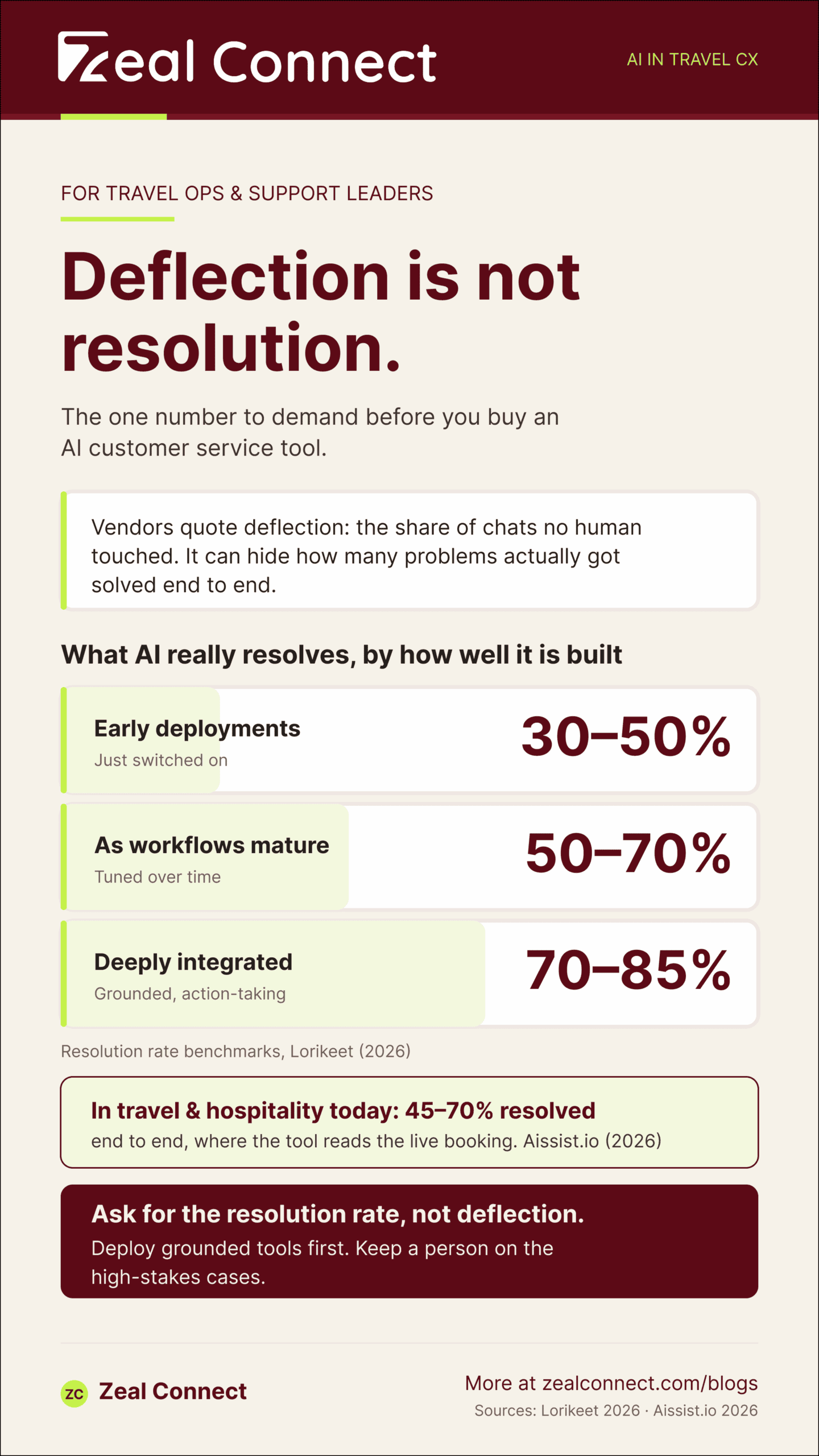
Deflection and resolution are not the same number, and the difference decides how you read every vendor claim.
Deflection counts conversations a human never touched. Resolution counts problems actually solved.
According to Lorikeet (2026), realistic 2026 resolution runs 30 to 50% for early deployments and only reaches 70 to 85% for deeply integrated, action taking agents. A high deflection figure can sit on top of a much lower resolution figure, so ask which one you are being quoted.
Why do AI customer service pilots stall before they reach production?
Pilots stall because the tool looks fluent but cannot read the booking. According to Deloitte Digital (2026), 38% of organizations across transportation, hospitality, and services are piloting agentic AI, but only 11% have it running in production. A demo tool answers from a generic knowledge base. A real travel ticket needs the supplier reference, the amendment history, and the fare rule. When the tool cannot see those, it hedges or invents, and the pilot quietly dies. Independent coverage from PhocusWire traces the same stall to legacy systems and fragmented data.
What travelers actually want from AI in travel customer service
Travelers care less about the method than vendors assume, and more about the outcome. In a survey of 1,000 US travelers, Ada (2026) found that half do not care whether the resolution comes from a human or from AI, as long as it gets resolved, yet 53% still expect a human available as a backup. That matters for tool choice. An AI tool earns its place by speed and accuracy on the right jobs, not by removing people the traveler still wants within reach.
The Five Categories of AI Tools for Customer Service in Travel
Once you stop trusting the pitch, you need a way to sort what is on offer. AI tools for customer service in travel are not one thing, and lumping them together is why comparisons go nowhere. Five categories cover almost every tool a vendor will show you. Learn the categories first, then judge any product by which one it is and how well it does that job.
What counts as an AI tool for customer service in travel?
An AI tool for customer service in travel is the use of artificial intelligence inside your support workflow, answering travelers, drafting replies, classifying tickets, extracting booking data, or predicting SLA breaches, running within the systems your team already uses. Some tools talk to the customer. Most of the useful ones help the agent or move data before anyone types a reply. Vendor overviews like Parloa's map these touchpoints across the journey.
The five categories of AI tools, from traveler facing to back office
Five categories, defined in one line each. Self service assistants are chatbots that answer travelers directly, often with translation built in. Voice AI handles natural language phone calls in place of rigid IVR menus. Agent assist copilots draft replies, summarize threads, and surface knowledge for a human agent. Back office and ops intelligence AI classifies, extracts booking fields, routes, predicts SLA breaches, scores sentiment, and reviews conversations for quality. Proactive and disruption AI predicts a delay and notifies the traveler before they contact you.
Traveler facing tools get the attention; ops facing tools do the work
The SERP talks almost entirely about the customer facing bot, which is the smaller half of the job. Most travel support time goes into the supplier and back office leg, chasing a hotel confirmation, reconciling an amendment, summarizing a 40 email thread. Those are jobs for agent assist and back office AI, not a public chatbot.
The category that gets the demo attention is rarely the one that clears your queue.
Key Terms Worth Knowing
A few terms that decide how you read any AI tool's numbers.
- Deflection rate: the share of conversations a human agent never touched. It counts avoidance, not solutions, so it flatters a tool.
- Resolution rate: the share of tickets where the traveler's actual problem was solved end to end. This is the number worth holding a vendor to.
- Grounding: tying an AI's answer to your real booking, policy, and supplier data, so it responds from the reservation rather than a generic guess.
- Agent assist copilot: AI that drafts replies, summarizes long threads, and surfaces knowledge for a human agent, who still reviews and sends.
- Agentic AI: AI that can take defined actions inside a workflow, such as updating a field or triggering a step, not just holding a conversation.
- Voice AI: natural language phone handling that understands what a caller says and replaces fixed IVR menus.
What Actually Works: Each AI Tool Category, Rated for Travel Operations
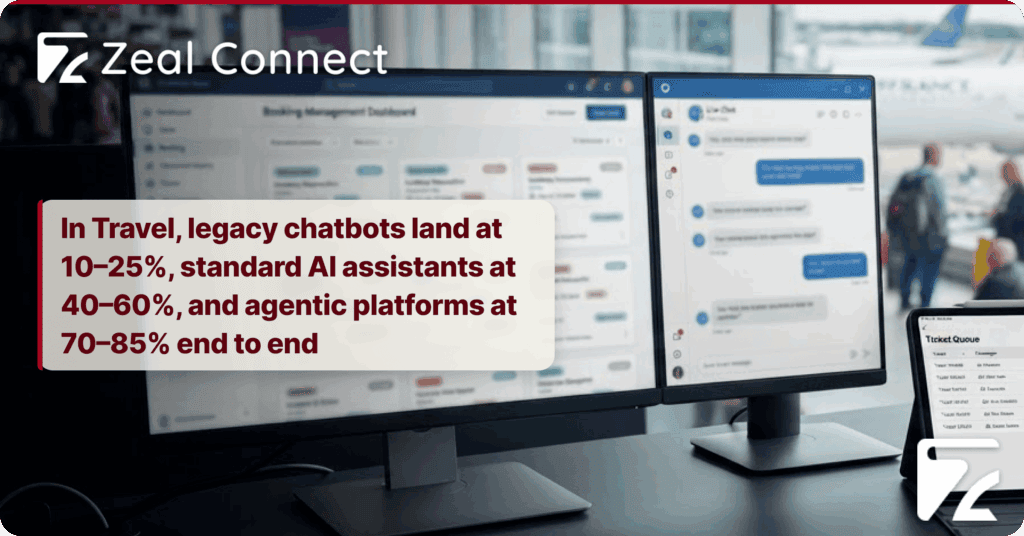
Now put each category against a real travel operation. The pattern is consistent: tools deliver on structured, low stakes, well grounded work, and fall short on messy, high stakes, poorly grounded work. Resolution tracks the category. According to Notch (2026), legacy chatbots land at 10 to 25%, standard AI assistants at 40 to 60%, and agentic platforms at 70 to 85% end to end. The table below sums up the read.
Where traveler facing chatbots and voice AI hold up, and where they don't
Chatbots and voice AI work well for structured, repeatable questions and fall short on disruption. They handle where is my confirmation, baggage rules, and simple date checks at scale, in many languages. They struggle the moment a case turns high stakes or emotional. When a flight is cancelled, travelers do not want a bot. In a survey of 7,000 business travelers, Perk (2025) found only 7% prefer an AI chatbot for rebooking during disruption, against 33% who want the phone. So deploy these tools for the easy volume, and route disruption to a person.
Why agent assist and back office AI deliver the most in travel operations
Agent assist and back office AI are the categories that clear a travel queue, and they get the least attention. They summarize a long supplier thread into one line, classify an incoming ticket by type, extract the booking reference and dates into fields, route by urgency, and flag an SLA about to breach. In travel and hospitality specifically, Aissist.io (2026) puts AI resolution at 45 to 70% where these tools are grounded in real data. The agent still writes the customer, but the preparation is done.
The highest payoff AI tools in travel are the back office ones nobody demos.
An AI tool is only as good as the booking data it can read
Grounding decides every row in the table above. A tool tied to your live booking and supplier record answers from the reservation.
A tool that cannot see the booking guesses, and a wrong guess carries real liability.
A tribunal held Air Canada responsible for its own chatbot's incorrect answer and ordered it to compensate the traveler, rejecting the argument that the bot was a separate entity (McCarthy Tétrault, 2024). Before you judge any category, ask what data it can actually read.
Table: What each AI tool category is sold as vs. what it delivers in travel customer service
| AI tool category | What it is sold as | What it delivers in travel ops | The tell, oversold or where it holds up |
|---|---|---|---|
| Self service assistant / chatbot | Handles most tickets | Structured FAQs, simple checks | Oversold on disruption and refunds |
| Voice AI | Replaces the call center | Routine calls, after hours triage | Oversold on complex, emotional calls |
| Agent assist copilot | Makes agents 10x faster | Drafts, summaries, faster handling | Holds up, agent still sends |
| Back office / ops intelligence AI | Invisible efficiency | Classify, extract, route, predict SLA | Holds up, highest payoff, least hype |
| Proactive / disruption AI | Prevents the contact | Alerts before the traveler calls | Holds up only with live data feeds |
Example AI tools by category
Examples, not endorsements. Most are horizontal tools that serve any industry.
- Self service assistants (front office): Intercom Fin, Ada, Zendesk AI, Tidio, Zeal Desk, Kommunicate. Traveler facing chatbots for structured questions.
- Voice AI: PolyAI, Parloa, Bland AI, Cognigy, NiCE. Natural language phone handling for routine call reasons.
- Agent assist copilots: Forethought, Cresta, Level AI, and the copilots inside Zendesk, Zeal Desk, and Intercom. Drafting and knowledge for a human agent.
- Back office and ops intelligence AI (travel operations): Zeal Desk travel native and enterprise grade, reads the live booking and supplier record natively to classify tickets, extract fields, route by urgency, and predict SLA breaches, alongside general purpose desks like Freshdesk, Zoho Desk, and Salesforce Service Cloud, which reach the same jobs through custom setup.
- Proactive and disruption AI: Ada and carrier built systems such as American Airlines' AURA, with disruption alerts now appearing across travel platforms. This category is the newest, so shipped examples are fewer.
Most of these are horizontal tools that serve any industry. For a travel operation the deciding factor is grounding: whether a tool reads your live booking and supplier record natively, or needs custom setup to get there.
How to Choose AI Tools for Customer Service in Travel That Deliver
Turn the verdict into a decision with three questions: what to put in first, where the tool must stop, and how to judge it past the demo. The order matters, because starting with the wrong category is how pilots become the 89% that never reach production. Choose by leverage and reversibility, not by which tool has the best demo.
Which AI customer service tool should you deploy first?
Start with grounded back office and agent assist tools, not a public bot. They carry the lowest blast radius and the highest leverage: if a summary or a classification is wrong, an agent catches it before the traveler sees anything. A customer facing chatbot does the opposite, exposing every mistake to the traveler and, as the Air Canada case showed, to a tribunal. Prove value on internal, reversible work first, then move outward to traveler facing tools once the data grounding is solid.
Where AI tools should stop and a person takes over
AI tools should stop at high stakes, money movement, and disruption cases. These are where a wrong answer costs the most and where travelers want a human anyway, recall that 53% still expect a person as a backup.
AI drafts and prepares; the agent reviews and sends.
No AI tool closes a refund dispute, a chargeback, or a relocation on its own. It assembles the context, and a person owns the decision and the reply.
How to evaluate an AI customer service tool beyond the demo
Judge a tool on four things the demo hides. First, grounding: can it read your live booking and supplier data, or does it need fields typed in? Second, travel workflow fit: does it understand amendments, HCNs, and supplier escalation? Third, proof: ask for resolution, not deflection. Fourth, cost per resolution, where Aissist.io (2026) benchmarks AI at $1 to $3 against $10 to $25 for a human, which is the math you take upstairs.
Conclusion
The AI tools for customer service in travel that actually work are the grounded ones aimed at the right job. Traveler facing bots earn their keep on structured, low stakes questions, then hand off. The real payoff sits in the back office and agent assist categories most buyers overlook, because they clear the supplier and amendment work that fills a travel queue. Whatever you evaluate next, sort it by category, demand a resolution number rather than a deflection one, and check what booking data it can actually read. Then deploy the reversible, internal tools first and keep a person on the cases that carry money, disruption, or risk. That order is what separates a tool that works from a demo that does not.
Frequently Asked Questions
What is the difference between deflection and resolution, and which should I hold a vendor to?
Deflection counts conversations no human touched, which can include travelers who gave up. Resolution counts problems actually solved end to end. Hold a vendor to resolution, and ask how they measure it, because a high deflection rate can hide a much lower resolution rate.
Do AI tools handle the supplier side of a travel ticket, or only the traveler side?
Back office AI works the supplier side, which most demos ignore. It summarizes long supplier threads, classifies the ticket, extracts the booking reference, and routes by urgency. The supplier does not use your tool, so the AI prepares the work and a person still sends the outbound message.
Which AI customer service tool should a travel company deploy first?
Start with grounded back office and agent assist tools, not a public chatbot. They carry low risk and high leverage, since an agent catches any mistake before a traveler sees it. Prove value on internal work, then move to traveler facing tools once your booking data grounding is reliable.
Can an AI tool resolve a travel ticket on its own?
Not the consequential ones. AI tools draft replies, summarize, classify, and suggest next steps, but a person reviews and sends anything involving money, disruption, or a policy decision. Travelers self serve on simple questions, and a human owns refunds, chargebacks, relocations, and the final reply.
How do I tell a travel native AI tool from a horizontal one with a travel page?
Check what it reads. A travel native tool pulls your live booking and supplier record onto the ticket automatically. A horizontal tool with a travel landing page usually needs those fields built through custom setup, so the travel logic lives in configuration rather than in the product.