



- This article explains what a helpdesk ticketing system for travel operations actually needs to do, why most generic help desks track only the customer conversation while the supplier side stays invisible, and what that gap costs the ops team.
- You'll get a working definition, the Three-Party Resolution Path (a reference table mapping five travel ticket types to their supplier dependency and data flow requirements), and evaluation criteria grounded in how travel support actually works.
- Written for operations and support leaders at OTAs, TMCs, DMCs, tour operators, consolidators, and travel payment companies.
Your helpdesk ticketing system for travel ops shows a clean SLA dashboard. First response times look healthy. Resolution rates are stable. But your agents are still chasing suppliers in a separate inbox, copying booking references by hand, and losing track of which tickets are waiting on a supplier versus waiting on an agent. The gap is structural. A generic helpdesk models a two party conversation: customer asks, agent answers. Travel support tickets involve three parties: the traveler, the agent, and the supplier. Most of the ticket's life is spent waiting on that third party, and the system does not see it.
Why Travel Ops Teams Outgrow Generic Helpdesk Ticketing Systems
Travel operations teams usually start on a generic helpdesk ticketing system, and it works at first. Tickets get logged, agents respond, and the SLA clock ticks. The cracks appear when volume grows and every second ticket depends on a supplier's confirmation, amendment, or refund action. Because at that point, the system tracks the agent's work but not the supplier's response.
What Makes a Travel Support Ticket Different From a Standard Helpdesk Ticket?
A standard helpdesk ticket is a conversation. A travel support ticket is an operational record. It carries booking data (PNR, HCN, check in dates, fare rules), depends on a supplier's response before the agent can resolve it, is time sensitive to travel dates, and carries financial consequences. According to U.S. PIRG (2025), complaints against U.S. airlines increased by nearly 9% in 2024 while passenger volume rose only 4%. That widening gap puts more pressure on travel ops teams to handle more complex, supplier dependent tickets faster. A help desk built for IT tickets or e-commerce returns does not model any of these traits.
Where Does the Helpdesk Ticketing System Start Losing Visibility in Travel Ops?
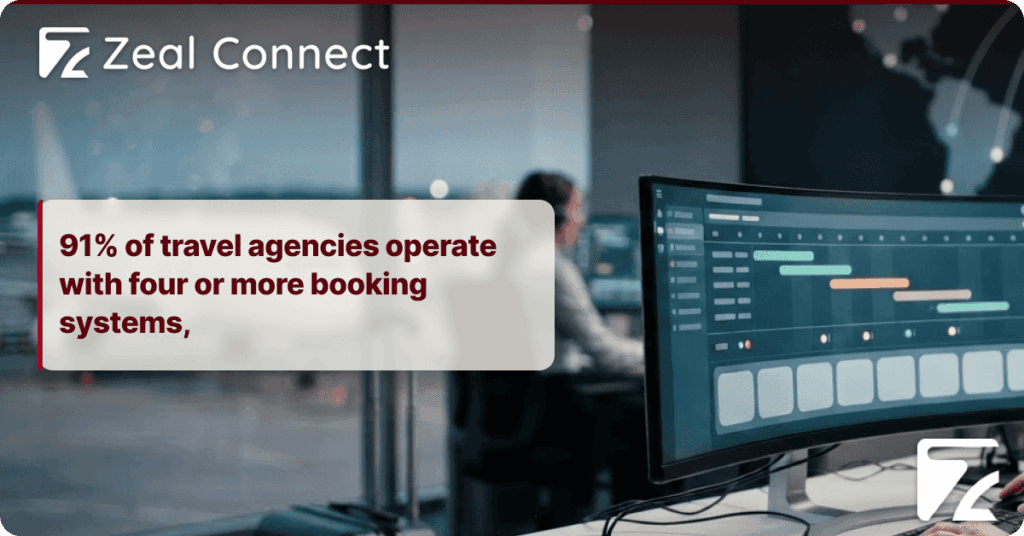
Visibility breaks at four specific points. First, the agent sends a supplier request and switches to a personal inbox or WhatsApp to chase it, because the travel help desk ticketing system has no supplier wait state. Second, the SLA timer counts total elapsed time but cannot separate agent time from supplier time, so the ops leader's performance reports are misleading. Third, a multi component booking (flight, hotel, transfer) spawns three unlinked tickets with no parent record. Fourth, a disruption event floods the queue with no auto classification. According to Sabre (2025), 91% of travel agencies operate with four or more booking systems, and more than half manage seven or more. That fragmentation is what your agents bridge manually every time the service desk ticketing system cannot.
A helpdesk ticketing system that tracks only the customer conversation gives you half the picture. The supplier side is where most travel tickets actually spend their time.
The Three-Party Resolution Path That Defines a Helpdesk Ticketing System for Travel Ops
A helpdesk ticketing system for travel ops is a support platform that tracks the full traveler, agent, and supplier resolution path for travel specific tickets, carrying booking data (PNR, HCN, dates, fare rules, financial amounts) between all three parties, measuring supplier wait time independently of agent response time, and supporting workflows for amendments, refunds, supplier chasing, and disruption events.
In travel support, most tickets follow a three party path: the traveler sends a request, the agent classifies it and links it to a booking, the agent sends a supplier action (and the ticket enters a supplier wait state), the supplier responds, the agent resolves, and the traveler is updated. A system that models only the first and last steps treats the supplier leg as invisible.
How Does the Traveler-Agent-Supplier Path Work Inside a Helpdesk Ticketing System?
The path has five stages. (1) The traveler creates a request through email, WhatsApp, or a web form. (2) The agent classifies the request, links it to the booking record, and identifies the supplier dependency. (3) The agent sends an action to the supplier (an amendment request, a refund claim, an HCN chase) and the ticket enters supplier wait state. (4) The supplier responds, and the agent reviews the response and resolves the ticket. (5) The traveler receives the update and the ticket closes with a complete audit trail. A helpdesk ticketing system for travel ops must support all five stages as distinct, trackable events. According to HubSpot (2024), 75% of customer service representatives saw their highest ever ticket volume in 2024. At that scale, losing visibility on the supplier leg is not a minor inconvenience; it breaks the operation.
What Data Must a Helpdesk Ticketing System Carry Between the Three Parties?
Each handoff in the resolution path requires specific booking data. Between the traveler and the agent: the booking reference, travel dates, and the nature of the request. Between the agent and the supplier: the PNR or HCN, fare rules or cancellation policy, financial amounts, and the supplier's contact and SLA deadlines. Between the supplier and the agent (on response): confirmation status, revised pricing, and settlement details. A generic helpdesk carries a subject line and a message thread. A travel support ticketing system carries the operational record. The mid office and back office systems that travel companies rely on for reconciliation and settlement sit downstream of this data. If the ticketing system does not carry it, agents re type it at every handoff.
Table: Three-Party Resolution Path by Travel Ticket Type
| Travel ticket type | Who initiates | Supplier dependency | Data the system must carry | Where a generic helpdesk loses the thread |
|---|---|---|---|---|
| Date change amendment | Traveler | Hotel/airline confirms new dates and pricing | Booking ref, original and new dates, fare difference, cancellation policy | No supplier wait state; amendment spawns unlinked ticket; pricing data lost |
| Supplier non confirmation (HCN chasing) | System or agent | Hotel issues HCN before check in deadline | Booking ref, guest name, check in date, supplier contact, follow up count | No follow up sequence; chasing moves to personal email; deadline invisible |
| Refund or chargeback | Traveler or payment system | Supplier confirms refundable amount and issues credit | Booking ref, payment ref, original amount, refund amount, settlement status | Financial data outside the ticket; no audit trail; refund chain breaks |
| Multi component itinerary change | Traveler | Multiple suppliers (airline, hotel, transfer) each confirm | Parent booking, child bookings per supplier, linked SLA timers | Each amendment becomes unlinked ticket; no parent/child visibility |
| Disruption event bulk triage | System or GDS alert | Airline confirms rebooking or cancellation per affected traveler | Affected PNRs, disruption type, rebooking options, priority tier | No auto classification; no bulk action; queue floods |
If the helpdesk ticketing system does not model the supplier as a party in the ticket, it cannot track the resolution path behind the majority of travel support requests.
Key Terms Worth Knowing
A few terms come up throughout this article on helpdesk ticketing systems for travel ops. Here is what each one means.
- Helpdesk ticketing system: software that logs, routes, and tracks support requests as individual records (tickets).
- Three party resolution path: the traveler, agent, and supplier dependency loop that defines most travel support tickets.
- PNR (Passenger Name Record): the booking container in a GDS; the reference that links a ticket to a reservation.
- HCN (Hotel Confirmation Number): the confirmation reference a hotel issues for a booking; often the data agents spend hours chasing.
- SLA (Service Level Agreement): the contracted response and resolution deadlines an ops team is measured against.
- IROP (Irregular Operations): airline industry term for disruption events (cancellations, delays, diversions) that trigger ticket surges.
How a Helpdesk Ticketing System for Travel Ops Handles the Workload Generic Desks Cannot
The three party resolution path looks clear on paper. In practice, the workload splits into three very different patterns: a predictable daily queue, a disruption surge, and a class of tickets that carry financial liability. Each pattern stresses the helpdesk ticketing system in a different way.
Steady State: What Does a Typical Day Look Like in a Travel Ops Helpdesk Ticketing System?
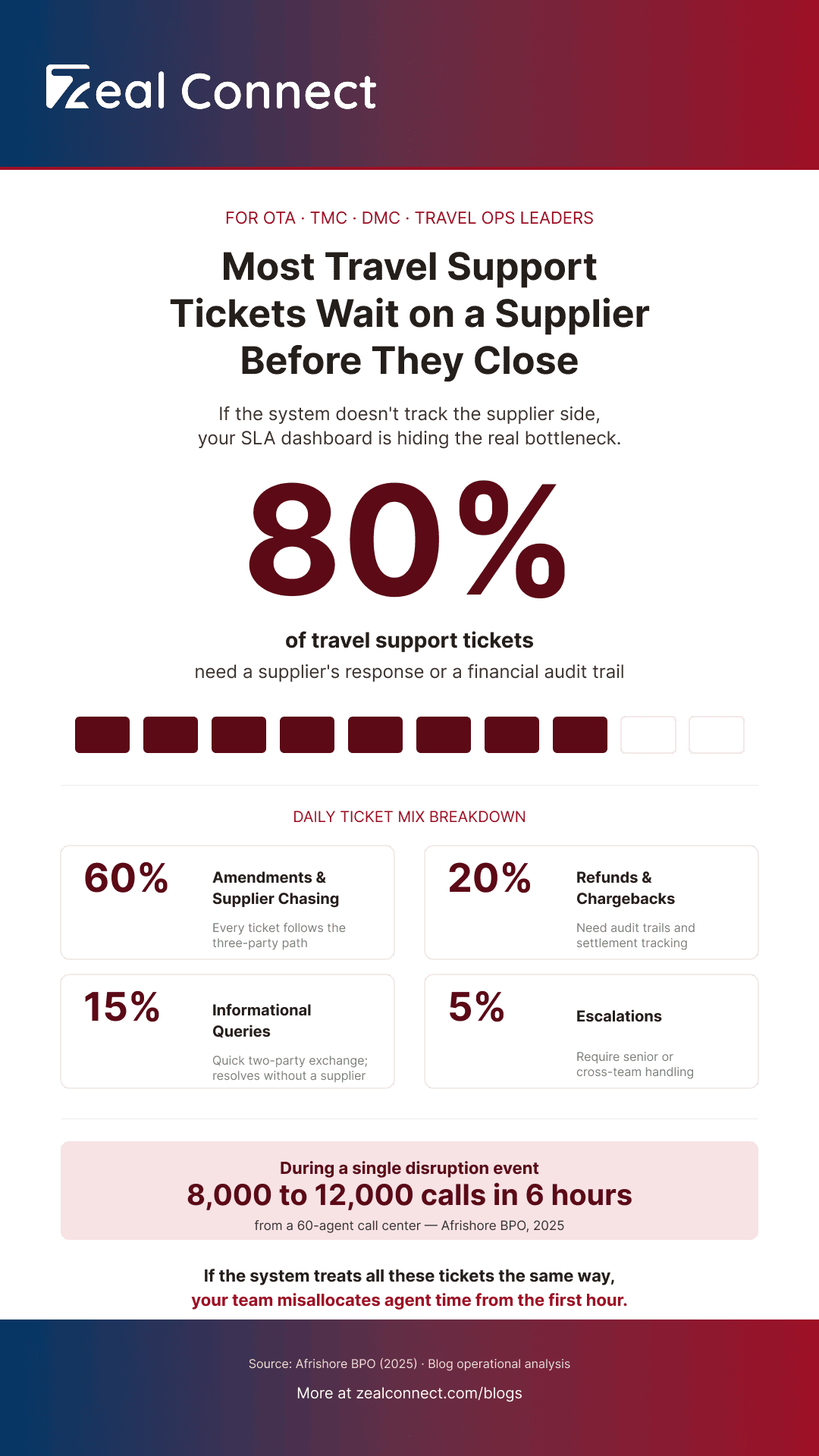
On a normal day, about 60% of the queue is amendments and supplier chasing, where every ticket follows the three party path. Another 20% is refunds and chargebacks, which carry financial weight and need audit trails. About 15% is informational (booking status, itinerary details) and resolves quickly as a two party exchange. The remaining 5% is escalations. According to Freshworks (2026), 40% of travelers expect a response within one hour, yet 73% expect consistency across channels while only 29% report receiving it. When the helpdesk ticketing system treats all of these ticket types as identical conversations, agents spend the same time on a quick status check as they do on a multi supplier amendment. That misallocation adds up.
The majority of travel support tickets (about 80%) require either a supplier's response or a financial audit trail. A system that treats them all as conversations misallocates agent time from the first hour of every shift.
Peak State: How Does the Helpdesk Ticketing System Hold Up During a Disruption Event?
A flight cancellation event can dump 300 or more tickets into the queue in two hours. According to Afrishore BPO (2025), during a major weather disruption a 60 agent call center faced 8,000 to 12,000 inbound calls within six hours, with hold times exceeding 45 minutes and abandonment rates past 60%. During events like these, the helpdesk ticketing system must auto classify tickets by disruption type, link each to the affected PNR, bulk assign by priority, and override normal SLA timers. A generic helpdesk has no concept of a disruption event. The queue floods, agents triage by hand, and the highest priority travelers wait alongside routine inquiries.
Financial Weight Tickets: Refunds, Chargebacks, and ADMs Inside the Helpdesk Ticketing System
Some travel tickets are also about money. A refund tracks through the customer, the agency, the OTA, and the supplier, with each party holding a piece of the settlement. A chargeback involves PCI sensitive card data. An ADM (Agency Debit Memo) is a financial penalty from an airline for a booking error. These tickets need field level audit trails, escalation rules tied to financial thresholds, and integration with settlement systems. According to Aissist.io (2026), self service AI resolutions cost $1 to $3 per ticket while human handled tickets cost $10 to $25 in travel and hospitality. Misrouting a financial weight ticket to a chatbot, or treating it identically to a booking inquiry, creates both a cost problem and a compliance risk.
How to Evaluate a Helpdesk Ticketing System for Travel Ops Before You Commit
Most vendor demos show a clean inbox, a routing rule, and an SLA timer. That tells you how the system handles IT tickets or e-commerce returns. It does not tell you whether the system can model the three party resolution path that defines your travel operation. The evaluation needs to test against your real workflows, not a feature checklist.
Run Your Hardest Ticket Types Through the Helpdesk Ticketing System Demo
Bring your actual ticket types to the evaluation: a date change amendment with a supplier dependency, a multi component itinerary change that spans three suppliers, and an HCN chasing sequence with a check in deadline. Run each through the demo. If the system flattens the supplier leg into a CC'd contact on a conversation thread, it does not model the three party path. According to TCN (2024), 73% of consumers would leave a brand after a single bad experience. Your hardest ticket types are the ones that create those bad experiences when the system cannot track them properly.
Ask Where Supplier Wait Time Shows Up in the Helpdesk Ticketing System Reporting
Request the SLA report during the demo and look for one specific thing: whether supplier wait time is a separate metric. If the report shows a single blended resolution time, the system cannot distinguish "waiting on us" from "waiting on them." Your agents may be meeting their response deadlines while the ticket sits with the supplier for 48 hours. Without two clocks (agent time and supplier time), your SLA dashboard gives you a misleading performance picture. Every ops leader who has been asked why resolution times are high, when the real answer was supplier delays, knows this gap.
If the SLA report cannot separate agent response time from supplier wait time, the helpdesk ticketing system does not model the third party.
Check Whether a Disruption Event Has a Dedicated Workflow in the Helpdesk Ticketing System
Ask the vendor to show what happens when 300 tickets arrive in two hours from a single flight cancellation. Look for auto classification by disruption type, bulk assignment by priority, and SLA timer overrides. If the answer is "you can tag them and sort manually," the system will not hold during a real IROP event. A standard help desk workflow is built for a steady, one at a time intake. Travel operations need a service desk ticketing system that recognizes a surge as a pattern and responds accordingly.
How Does a Helpdesk Ticketing System Built for Travel Ops Handle the Three-Party Resolution Path?
Zeal Desk is built for travel operations, not adapted from a general purpose help desk. Where horizontal platforms (Zendesk, Freshdesk, Zoho Desk) treat every participant as a contact on a conversation thread, Zeal Desk models the traveler, agent, and supplier as distinct parties with their own workflows, data requirements, and SLA timers.
How Does Zeal Desk Track the Supplier Leg of a Travel Support Ticket?
Zeal Desk treats the supplier as a first class participant in the ticket, not a CC'd contact. Supplier follow up sequences run inside the ticket record. When a ticket enters supplier wait state, the system tracks supplier response time as a separate metric, so the ops leader's SLA reports distinguish agent performance from supplier delays. The integration hub pulls live booking data from external APIs, which means the agent and the system work from the real reservation rather than a re typed summary. A general purpose helpdesk has no concept of a supplier wait state because it was never designed around a three party workflow.
How Does Zeal Desk Keep Every Ticket Linked to Its Booking?
Work in Zeal Desk is organized around bookings, not isolated tickets. Parent/child linking holds a booking and its amendments (or a group booking with many travelers) as one connected case. AI booking extraction automatically links the referenced booking to the ticket and maps data (PNR, HCN, dates, amounts) onto configurable fields. When three amendments to the same booking come in, they appear as children of one parent record. The agent sees the full booking health, and the ops leader does not chase scattered tickets to understand one traveler's case.
How Does Zeal Desk Handle the AI Layer Without Replacing the Agent?
Zeal Desk's AI layer classifies incoming tickets by the operation's own categories, extracts booking references and financial amounts, and summarizes long supplier threads into a concise brief. For cases that need a human, auto next action suggests the next step, grounded in the knowledge base and live booking data. The agent reviews the suggestion and sends the reply. AI drafts; the agent decides and sends. According to AtlasPerk (2026), only 16% of travel businesses have deployed chatbots, yet 91% of customer service leaders face pressure to implement AI. Zeal Desk addresses that gap with an AI layer that assists the agent rather than replacing them, which fits an industry where supplier dependencies and financial stakes make full automation risky.
Conclusion
A helpdesk ticketing system for travel ops is defined by one structural question: does it track the full resolution path, including the supplier leg, or does it stop at the customer conversation? Generic help desks model a two party exchange and leave the third party invisible. The three party resolution path (traveler, agent, supplier) is not a niche requirement. It is the workflow behind the majority of travel support tickets: amendments, supplier chasing, refunds, multi component changes, and disruption events. The ops leader who evaluates a system against this path, by testing real ticket types, checking for separate supplier time reporting, and asking about disruption workflows, will see immediately whether it fits travel or just fits a checklist. The clean SLA dashboard your team sees today may be hiding the supplier side. Now you know where to look.
Frequently Asked Questions
What is a helpdesk ticketing system for travel operations?
It is a support platform that tracks the three party resolution path (traveler, agent, supplier) for travel specific tickets. Unlike generic help desks that model two party conversations, a travel native helpdesk ticketing system carries booking data (PNR, HCN, dates, fare rules) between all three parties, tracks supplier wait time as a separate metric, and supports workflows for amendments, refunds, and disruption events.
Why can't a generic helpdesk ticketing system handle travel support tickets?
Generic systems model a customer agent conversation thread. Travel support tickets depend on a supplier's response before the agent can resolve them. Without a supplier wait state, booking centric linking, or disruption event classification, the system treats every ticket identically. Agents compensate by working outside the system, which breaks visibility, inflates SLA reports, and creates audit gaps.
What is the three party resolution path in travel support?
It is the five stage workflow most travel tickets follow: (1) the traveler sends a request, (2) the agent classifies and links to the booking, (3) the agent sends a supplier action and the ticket enters supplier wait, (4) the supplier responds and the agent resolves, (5) the traveler is updated. SLA accuracy depends on tracking all five stages separately.
How does a helpdesk ticketing system handle disruption events in travel?
During an IROP event (flight cancellation, weather disruption, mass schedule change), the system must auto classify incoming tickets by disruption type, link each to the affected booking or PNR, bulk assign by priority tier, and override normal SLA timers. Without these capabilities, the ops team triages hundreds of tickets manually during the worst possible moment.
Does AI in a helpdesk ticketing system replace the travel support agent?
No. AI classifies tickets, extracts booking data, summarizes supplier threads, and suggests next steps. The agent reviews the suggestion, makes the decision, and sends the reply. Travelers can self serve for simple queries like booking status. However, for amendments, refunds, supplier chasing, and anything with financial weight, a person owns the resolution and the customer facing response.