



- This article maps the six types of travel support ticketing systems travel companies actually use for customer support: GDS queues, shared inboxes, generic help desks, booking engine embedded modules, travel native platforms, and BPO bundled desks.
- You will get a plain definition of each type, a System Type Map showing where each one works and where it breaks, and a set of trigger signals for knowing when your operation has outgrown its current system.
- Written for operations and support leaders at OTAs, DMCs, TMCs, tour operators, and travel payment companies.
Search for a travel support ticketing system and you will find a wall of product names. Zendesk, Freshdesk, Kapture, Zoho Desk, and a dozen others appear side by side, as if the only decision is which vendor to pick. But the results mix booking platforms with help desks with BPO services in one list. Nobody maps the types of systems available. Meanwhile, some travel companies still run all of their support through Amadeus queues or a shared Gmail inbox and have never evaluated whether a structured alternative exists. The first decision is not which product to buy. It is which category of system your operation actually needs.
Why Travel Companies Run Six Different Types of Support Ticketing Systems
Six distinct types of travel support ticketing systems exist because travel operations are not one market. A five person DMC handling supplier emails out of a single inbox has nothing in common, operationally, with a 500 agent OTA processing thousands of refund requests per day. The SERP treats them as one buyer. They are not. Before you compare products, you need to know which system category your operation sits in. That category depends on your ticket volume, your supplier dependency, and your compliance load.
What Makes Travel Support Ticketing Different From Other Industries?
Travel support carries structural traits that most industries do not share. Every ticket can involve multiple suppliers (a hotel, an airline, a ground handler) who each control part of the resolution. Booking deadlines create time pressure that generic SLA timers do not capture. Financial weight follows every interaction: refunds tied to fare rules, chargebacks, ADMs, and PCI compliance. According to the U.S. PIRG Education Fund (2025), complaints against U.S. airlines increased by nearly 9% in 2024 even though passenger volume rose by only 4%. Volume is climbing, and the tickets hitting travel support desks are more complex than a password reset or a billing question.
Every travel support ticket carries financial and regulatory weight that generic ticketing systems were never built to track.
How Did Travel Companies End Up With So Many Different Ticketing Systems?
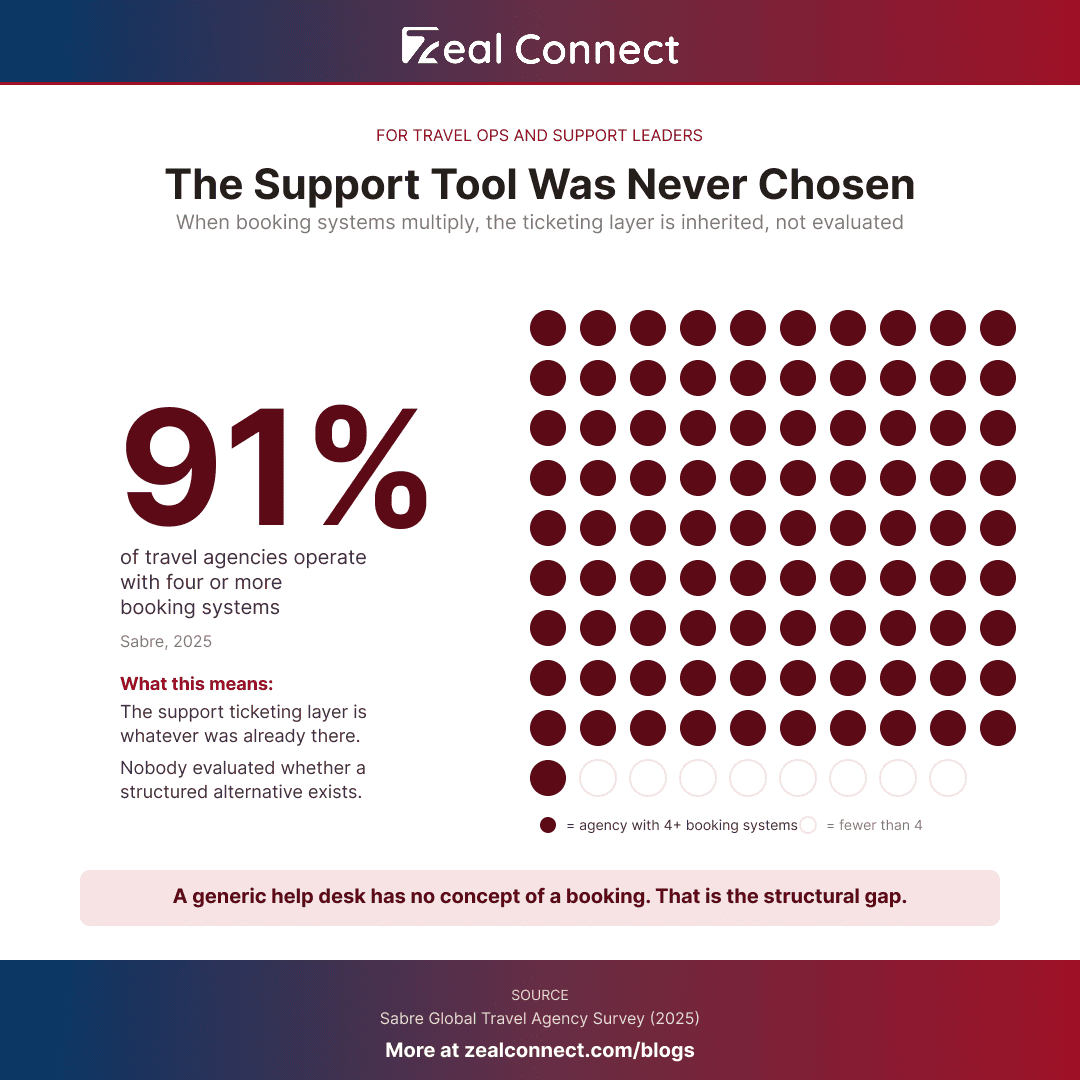
The fragmentation is historical, not intentional. Agencies started by managing support through GDS queues because Amadeus or Sabre was already open on every screen. Others relied on a shared inbox (booking@ or ops@) for years before the volume made it unworkable. Some bolted on a generic help desk. Some inherited whatever platform their BPO brought. According to Sabre (2025), 91% of travel agencies operate with four or more booking systems, and more than half manage seven or more.
When four to seven booking systems feed your operation, the support ticketing layer tends to be whatever was already there, not something anyone deliberately chose.
The Six Types of Travel Support Ticketing Systems Defined
A travel support ticketing system is a platform that organizes, routes, and tracks customer service requests for travel companies. It converts inbound messages from email, chat, phone, and web forms into structured tickets with assigned owners, response deadlines, and resolution workflows linked to bookings, suppliers, and travel dates.
Travel companies use six structurally different types of these systems. Each one organizes work differently, fits a different stage of operational maturity, and breaks at a different point. The table below is a System Type Map: a reference for identifying which type you are running today and where it stops working.
GDS Queues and Shared Inboxes as Travel Support Ticketing Systems
GDS queues and shared inboxes are the two types most travel industry articles ignore, because neither is marketed as a "ticketing system." Yet both function as one for thousands of agencies. A TMC running support through Sabre queues is using a ticketing system. So is a DMC managing customer issues from a shared Gmail inbox.
The work gets done, but there is no SLA tracking, no automated routing, no reporting, and no way to see who is handling what.
These systems persist because they are free and familiar. They break the moment volume or accountability requirements grow.
Generic Help Desks and Booking Engine Embedded Travel Ticketing Modules
Generic help desks (Zendesk, Freshdesk, Zoho Desk) work across every industry, which is both their strength and their limit. They offer routing, SLA timers, and reporting out of the box. But they have no concept of a booking, a supplier, or a travel date. Every travel specific field becomes a custom add on. Booking engine embedded modules take the opposite approach. Platforms like Tourplan, TravelCarma, and iVector include complaint handling and amendment tracking inside the reservation system. They know the booking, but they typically lack multi channel intake, configurable routing, and standalone SLA enforcement. The help desk and ticketing software market was valued at $14.4 billion in 2026 (Verified Market Reports), and travel companies are buying from that market with no map of which category actually fits.
Travel Native and BPO Bundled Travel Ticketing Systems
Travel native platforms are built for travel from the data model up. The booking is the unit of work, not a custom field. Supplier coordination, travel SLAs tied to departure or check in dates, and booking centric parent/child linking are first class features, not workarounds. BPO bundled desks sit at the other end. When a travel company outsources support, the BPO brings its own ticketing platform. The travel company rarely chooses the software. According to Grand View Research (2025), the global travel BPO market was valued at $3.95 billion, which means nearly $4 billion in travel support runs on systems the travel company does not own. The trade off is capability versus data ownership.
Table: Six types of travel support ticketing systems compared
| System type | What it is | Best fit operation | Where it breaks | When to move on |
|---|---|---|---|---|
| GDS queue ticketing | Amadeus/Sabre queues used as task managers | Small agencies with airline heavy bookings | No SLA tracking, no routing, no reporting | Volume exceeds what queues can organize |
| Shared inbox | Email based support with no dedicated platform | Early stage DMCs, small operators | No assignment visibility, no SLA enforcement | Team grows past 3 agents sharing one inbox |
| Generic help desk | Zendesk, Freshdesk, Zoho Desk (cross industry) | Any company needing basic routing and SLA timers | No booking awareness, every travel field is custom | Customization cost exceeds the subscription |
| Booking engine embedded | Support module inside Tourplan, TravelCarma, iVector | Tour operators already on that booking platform | Limited routing, no multi channel intake | Ticket complexity outgrows the module |
| Travel native platform | Purpose built for travel (booking centric data model) | Mid to large OTAs, TMCs, multi supplier operations | Higher setup investment than a generic desk | Rarely outgrown if it scales with volume |
| BPO bundled desk | Outsourcer's platform (Fusion CX, EverHelp, etc.) | Companies outsourcing support fully or partially | Company loses access to ticket data and SLA reporting | You need visibility the BPO will not give you |
Key Terms Worth Knowing
A few terms come up throughout this article on travel support ticketing systems. Here is what each one means.
- GDS queue: A task management function inside Amadeus, Sabre, or Travelport where agents pick up and process booking related work items in sequence.
- PNR (Passenger Name Record): The booking container that links a traveler's itinerary across airline, hotel, and agency systems. It is the primary reference for support tickets in air heavy operations.
- SLA (Service Level Agreement): Contracted response and resolution time targets that drive operational ticketing priorities and escalation rules.
- BPO (Business Process Outsourcing): Outsourcing the support function, including the ticketing platform, to a third party provider who staffs, manages, and often controls the tooling.
- Mid office / back office: The post booking operations layer (reconciliation, accounting, settlement) that sits behind the customer facing support desk. Distinct from the ticketing system but often confused with it.
- Booking centric ticketing: Organizing support work around a booking record (with its dates, suppliers, travelers, and financial data) rather than around a standalone conversation thread.
Which Type of Travel Support Ticketing System Fits Each Operation
The right type of travel support ticketing system depends on four variables: ticket volume, supplier dependency, compliance load, and team size.
A travel payment company processing chargeback disputes has different system needs than a tour operator handling itinerary changes. According to Salesforce (2025), 58% of service leaders cited rising ticket volume as a top operational challenge. Volume alone can push a company from one system type to the next, but it is rarely the only factor.
Travel Support Ticketing for High Volume OTAs and TMCs
High volume operations processing more than a thousand tickets per day need either a travel native platform or a BPO bundled desk. A generic help desk at that scale buries the team in custom fields and manual tagging. A GDS queue cannot handle that throughput. The deciding factor is whether you want to own the system and the data, or whether you are willing to hand both to an outsourcer in exchange for staffing flexibility. OTAs running amendment and refund queues at scale typically need booking aware routing and supplier coordination inside the same platform, not bolted on.
Travel Support Ticketing for DMCs and Tour Operators
DMCs and tour operators typically sit between a booking engine embedded module and a standalone platform. Some run support inside their reservation system (Tourplan, TravelCarma) because it already knows the booking. That setup works until supplier coordination, SLA enforcement, or multi channel intake outgrows what the module can do. According to Automate.travel (2026), 39% of tour operators still operate without any booking software at all. For those operators, the jump is not from one system type to another. It is from no system to a first one.
39% of tour operators have no booking software at all. Their first system decision is not which type to upgrade to. It is whether to start with one.
Travel Support Ticketing for Payment Companies and Consolidators
Travel payment companies and consolidators handle a fundamentally different kind of ticket. Their support queue is not traveler complaints. It is financial disputes: ADMs, chargebacks, settlement errors, and reconciliation mismatches. These tickets need compliance fields (PCI, BSP cycle tracking), audit trails, and links to the settlement record. A generic help desk does not model any of this. A travel native platform with financial workflow support, or a heavily customized generic desk, are the two viable options. The question is whether the customization cost is justified.
Five Signals That Your Travel Support Ticketing System No Longer Fits
Knowing the six types is the first step. Knowing when to move from one to the next is the harder call. Most travel companies do not switch systems because someone evaluated the market. They switch because the current setup visibly broke. These five signals tell you the break is coming before it arrives.
When Supplier Threads Outgrow Your Travel Support Ticketing Queue
The first signal is supplier conversations living outside the ticketing system. Agents chase hotels through forwarded emails. WhatsApp side channels carry urgent supplier updates that never reach the ticket. Personal inboxes hold confirmation threads that the rest of the team cannot see. If supplier coordination happens in a parallel system, your ticketing setup is not capturing the full picture of the work. This is common in operations running on shared inboxes or generic help desks, because neither type was built to track supplier threads alongside customer requests.
When SLA Breaches Go Undetected in Your Travel Ticketing System
The second signal is SLA measurement that does not connect to travel deadlines. A generic SLA timer counts hours from ticket creation. But in travel, the real deadline is often the departure date, the check in date, or the BSP settlement window. If your system measures response time in isolation without linking it to the booking's own timeline, SLA breaches go undetected until a traveler misses a flight or a refund window closes. According to Salesforce (2025), 62% of leaders who deployed automation in 2024 reported human agent ticket volume was flat or higher in 2025. More automation has not reduced the volume, so the SLA problem is growing, not shrinking.
When Your Team Works Around the Travel Support Ticketing System More Than Inside It
The third signal is the workaround stack. Spreadsheets track amendments because the system cannot link them to the original booking. Manual tags substitute for booking references the system does not extract. Separate reporting tools pull data the ticketing platform cannot surface. If the time your team spends working around the system rivals the time they spend inside it, the problem is not configuration. The system category is wrong for your operation.
A shared inbox cannot be configured into a help desk. A generic help desk cannot be configured into a booking aware platform. At some point, the category itself needs to change.
How Does a Travel Native Ticketing System Handle What the Other Five Types Cannot?
A travel native platform is the fifth type in the taxonomy above, and it is built to fill the gaps the other five leave open. Rather than adapting a general purpose tool to travel, it starts from the booking as the unit of work and builds outward. Zeal Desk is one example. Here is how the travel native category handles the three areas where other system types consistently break.
How Does Booking Centric Ticketing Work in a Travel Native Support System?
In a travel native platform like Zeal Desk, the booking is the ticket. Parent/child linking connects a booking to its amendments, related travelers, and supplier interactions as one case. Live booking data pulled through integrated APIs means agents and AI work from the actual reservation record, not a retyped summary pasted into a custom field. Travel specific fields (PNR, check in and check out dates, supplier references, HCN) are first class data, not bolted on custom fields that someone has to maintain. This is the structural difference from a generic help desk, where every one of those fields is a manual setup.
How Does AI Classification Differ in a Travel Support Ticketing System?
AI in a travel native system classifies by travel specific categories: amendment, cancellation, supplier escalation, ADM dispute, reconfirmation. It extracts booking data automatically and summarizes long supplier email chains into a concise brief. In a generic desk, AI classifies by generic intent categories that do not map to travel workflows. Zeal Desk's AI layer handles classification, extraction, and summarization grounded in booking data. It drafts the reply. The agent reviews, edits, and sends it. The human owns the decision, and no customer message goes out without a person approving it.
Why Does a Travel Company Lose Visibility When the Ticketing System Belongs to a BPO?
When the outsourcer controls the platform, the travel company loses direct access to ticket data, SLA reporting, and AI training data. According to Deloitte (2024), 42% of companies now cite access to specialized talent as their top outsourcing driver, which means the BPO relationship is increasingly about capability. But capability without visibility is a blind spot. A travel native platform owned by the travel company, with BPO agents working as users inside it, preserves both the talent access and the data ownership. The company keeps its reporting, its SLA history, and its operational intelligence regardless of who staffs the queue.
Conclusion
The first decision in choosing a travel support ticketing system is the system type, not the vendor name. Six categories exist because travel operations are not one market. A TMC on GDS queues, a DMC inside a booking engine's support module, and an OTA on a BPO bundled desk are all running "ticketing systems," but they are running fundamentally different types. Start by identifying which type you are on today. Then use the five trigger signals to know whether it still fits. If supplier threads live outside the system, if SLAs do not connect to travel dates, or if your team's workaround stack keeps growing, the category needs to change. The System Type Map above is the reference for making that call.
Frequently Asked Questions
What is the difference between a GDS ticketing queue and a support ticketing system for travel?
A GDS ticketing queue (Amadeus QT/QS, Sabre queues) is a task management function inside a reservation system. It organizes booking related work items for agents to process in sequence. A support ticketing system is a dedicated platform for managing customer issues: routing, SLA tracking, multi channel intake, and reporting. Some agencies use GDS queues as their de facto support system, but queues lack the tracking and accountability features a dedicated platform provides.
Can a generic help desk like Zendesk or Freshdesk work for a travel company?
Yes, at small scale or with significant customization. Generic help desks handle routing, SLA timers, and basic reporting well. They break down when the operation needs booking aware fields, supplier coordination, or travel date linked SLAs, because all of these require custom setup. Once the cost of customizing and maintaining those workarounds approaches the cost of a purpose built platform, the generic desk stops being the practical choice.
How does a BPO bundled ticketing system differ from an in house travel support platform?
A BPO bundled system belongs to the outsourcing provider. The travel company gets staffing and support capacity but gives up direct control of ticket data, SLA reporting, and platform configuration. An in house platform (whether generic or travel native) keeps data ownership with the travel company. The key trade off is staffing flexibility versus operational visibility, and companies that need both often run their own platform with BPO agents as users.
When should a travel company switch from a shared inbox to a dedicated ticketing system?
Three signals indicate the shared inbox has reached its limit. First, you cannot see who is handling which ticket without asking. Second, SLA commitments exist but nothing tracks whether they are met. Third, your team spends meaningful time sorting, tagging, or forwarding emails manually. Once any of these becomes a daily friction point rather than an occasional inconvenience, a dedicated system pays for itself in recovered time and accountability.
What does "travel native" mean when applied to a support ticketing system?
Travel native means the platform was built for travel from the data model up. Bookings, suppliers, travel dates, PNRs, and HCNs are native objects in the system, not custom fields added on top of a general purpose structure. Supplier coordination, booking linked SLAs, and parent/child ticket relationships are built in workflows. The distinction matters because a generic desk can be customized to handle some of these, but the maintenance burden grows as the operation scales.