




This article explains what automated customer service for travel really means once you are past the pitch deck. It is not a switch you throw. It is a task by task decision about where AI acts and where a person takes over. Written for ops, support, and CX leaders at any travel company, whether an OTA, tour operator, DMC, TMC, or travel payments firm, it gives you a working definition, the three things that decide any handoff, a table of eight common travel tickets with the exact point at which AI stops, and the discipline that keeps those lines honest after go live.
Someone on your leadership team will ask how much of customer service you have automated. It sounds like a question with a number for an answer. It isn't. The honest answer is a list of tickets and the exact point on each one where AI stops and a person takes over. Automated customer service for travel isn't a switch you flip on. It's a set of decisions, task by task, and the decision most teams skip is where that line sits. The shift is already here: AI is expected to handle half of all customer service cases by 2027, up from 30% today (Salesforce, 2025). In travel, 61% of businesses are already experimenting with or scaling agentic AI (Phocuswright, 2026).
Why Automated Customer Service for Travel Is Now a Configuration Decision, Not a Strategy Debate
The argument about whether to adopt AI is over. Almost everyone has. What's left is the harder, less glamorous work of deciding what to hand it, and that work happens ticket by ticket, not in a strategy deck. Meanwhile the pressure keeps climbing, because travel demand and complaint volume are both rising faster than headcount.
What's driving the automated customer service question in travel today?
Complaints are growing faster than the business. Customers lodged a record 66,675 complaints against U.S. airlines in 2024, a 9% rise while passenger volume grew only 4% (U.S. PIRG, 2025). Every travel operator feels a version of this. A weather event or a schedule change turns a normal Tuesday into a queue that buckles. You can't hire your way out of a spike that lasts three days, so the pressure to automate is real and immediate. But pressure alone doesn't tell you what to automate.
Automated customer service for travel is no longer about whether you've adopted AI.
Adoption is close to universal, so simply having AI running isn't the differentiator anymore. Across the wider service world, 95% of service centers have already implemented AI (Roland Berger, 2025). The teams that get value aren't the ones that switched AI on first. They're the ones who decided exactly where AI acts and where it stops. That decision is the work. Skipping it is how a deployment stalls after the demo, when a rare ticket type shows up and the AI answers it with confidence it hasn't earned.
Why "how much have we automated?" is the wrong question.
A percentage hides the thing that matters. Two desks can both report "60% automated" and run completely differently. One drafts and lets agents send, the other lets AI act on money without review. Answer the real question for each ticket type and you have something you can configure, audit, and defend to your CTO. Answer "how much" and you have a slide, not a system.
The useful question isn't how much you have automated. It's at what point in which task.
What Does "Automated Customer Service for Travel" Actually Mean at the Task Level?
Automated customer service for travel is the use of AI to act on support requests across email, chat, and messaging, reading them, understanding them, drafting replies, and taking low risk actions, with a defined point on each ticket where the case passes to a human agent. That last clause is the whole thing. Without it, AI either escalates everything, which wastes the investment, or nothing, which is how a wrong answer reaches a traveler.
What is automated customer service for travel, in one paragraph?
It's AI acting on the front line of travel support: taking a request in from email, chat, WhatsApp, or a web form, working out what it's about, pulling the booking, drafting a response, and completing the tasks it's cleared to complete, while a defined trigger hands anything past that line to a human. Gartner scopes its own forecast this way, predicting agentic AI will handle 80% of standard customer service queries by 2029, while complex judgment cases stay with people (Gartner via TechMonitor, 2025). The word doing the work in that sentence is "standard."
The three things that decide any handoff: grounding, reversibility, and blast radius.
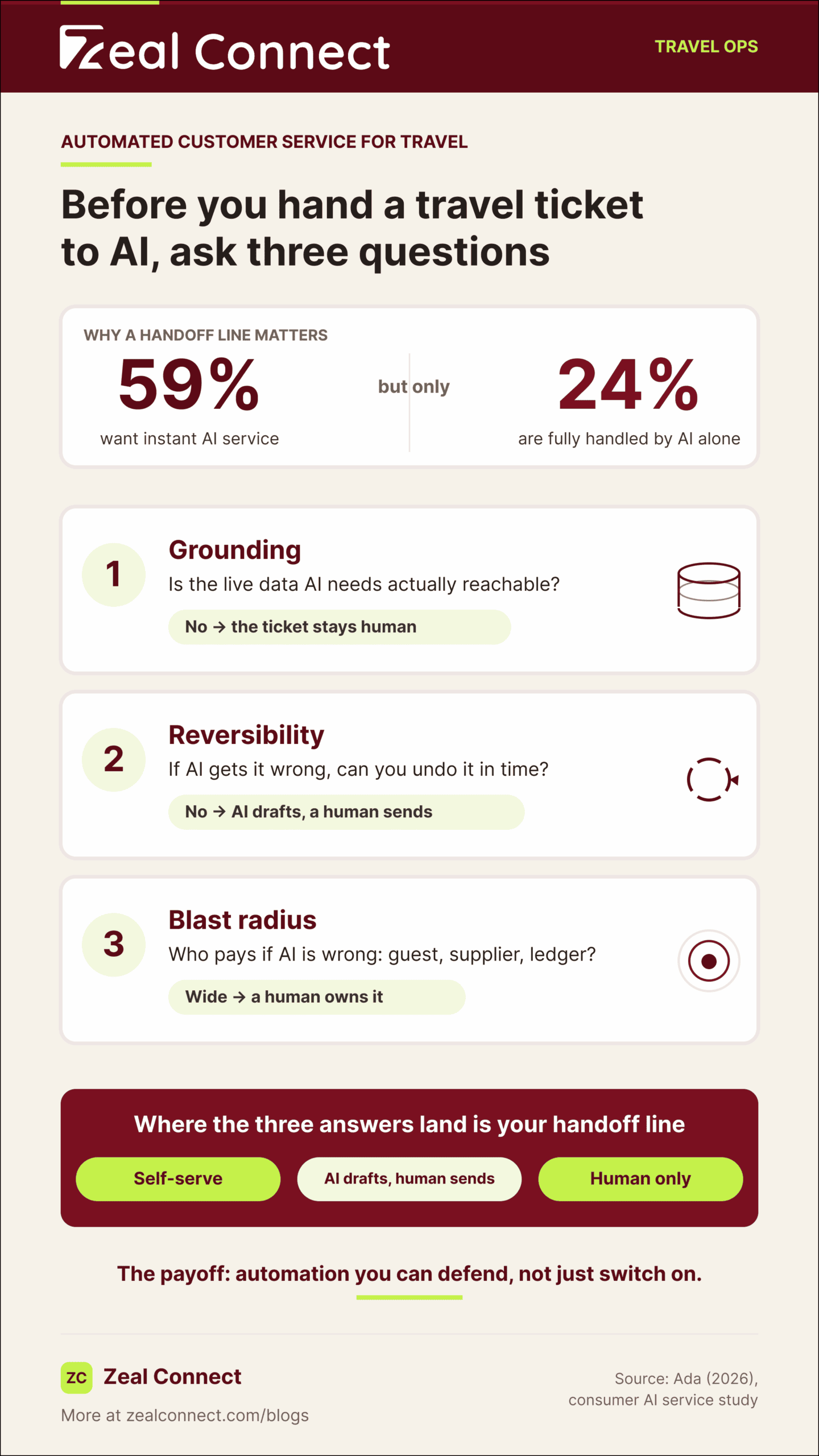
Where the line sits on any ticket comes down to three questions. First, grounding: is the data AI needs to answer this actually reachable right now, the live booking, the fare rule, the supplier's status? Second, reversibility: if AI acts and gets it wrong, can you undo it inside the operational window? Third, blast radius: who eats the mistake, the guest, a supplier, a regulator, the brand, or your ledger? A well grounded, reversible, low blast radius question can be self served through AI with no agent needed. Change any one answer and a person steps in sooner.
On any travel ticket, the handoff line comes down to three things: whether the data is grounded, whether the action can be undone, and who pays if the AI is wrong.
What automated customer service for travel is not.
It is not an AI that quietly settles every case on its own. The demand for speed is real. 59% of consumers prefer instant, 24/7 AI service over waiting for a human, but only when it can actually handle their issue (Ada, 2026). And the gap shows up next to it: only 24% say their most recent AI interaction was fully handled by AI alone. The other 76% needed a person. That gap is the handoff line, showing up in the data.
Key Terms Worth Knowing
Five terms that make the rest of this piece easier to act on.
- Handoff line: the exact trigger at which AI stops working a ticket and a human takes over. Pure questions are self service, where the traveler gets an answer and no agent is needed; every ticket that involves an action has a line before AI acts, where AI drafts and a person sends.
- Grounding: the live data an AI needs to be reading before it can safely act, the booking record, the current policy, the supplier's confirmation status. Ungrounded AI guesses confidently.
- Reversibility: whether an action taken on a ticket can be undone inside the operational window. A courtesy message is reversible. An issued ticket, a cancelled supplier hold, or a processed chargeback often is not.
- Blast radius: who takes the cost when AI is wrong on a task, the traveler, a supplier, a regulator, the brand, or the ledger. Wider blast radius means an earlier handoff line.
- Deflection vs. resolution: deflection ends the contact; resolution finishes the case. They are different bars, and they need different handoff lines.
The Handoff Line for Eight Common Travel Tickets: What AI Does, and Where It Must Stop
This is the table worth printing. For eight ticket types nearly every travel desk handles, this is what AI can reasonably do, the trigger that hands the case back, and what the person then owns. The pattern underneath is the three questions from the last section, grounding, reversibility, and blast radius, applied one ticket at a time.
Table: The handoff line for eight common travel customer service tickets
| Ticket type | What AI does | Handoff trigger (the line) | What the human then owns |
|---|---|---|---|
| Flight status / itinerary check | Answers instantly from live booking and supplier feed | The moment the traveler wants to act, not just ask | Any change the traveler then requests |
| Rebooking, same fare class | Offers eligible alternatives from live inventory | Option outside the eligible set, or three declines | GDS override, guest recovery |
| Refund, fully refundable, in window | Verifies eligibility, drafts, processes to a value cap | Cap breach, partial calc, or supplier not confirming | Cap approval, partial math, supplier chase |
| Refund, non refundable or goodwill | Reads case, retrieves policy, drafts reply | Before any money moves, every time | Judgment, exception approval, send |
| Supplier chase for confirmation | Sends chaser, tracks window, escalates by cadence | Second chaser missed, or an exception reply | Negotiation, guest requote |
| Visa / entry requirement question | Retrieves current requirement, drafts reply | Before sending, every time | Verify, send |
| Cancellation with penalty | Computes penalty from fare rules, drafts message | Before the action, every time | Confirm intent, execute, send |
| Disruption / IROPs mass event | Pushes proactive messages, offers preapproved options | Escalation language, VIP, or special service flag | Recovery, VIP contact, exception routing |
Which travel tickets can a traveler self serve through AI?
The tickets that need no agent are the pure informational ones. A flight status check is well grounded (the answer sits in the live booking), asks for no action, and carries almost no blast radius, so the traveler self serves and no ticket reaches a person. Same fare class rebooking sits just past that line. AI can offer the eligible options, but the moment it becomes an action a person owns the exceptions. These are the wins the market keeps citing. Early adopters unifying AI with traveler context report double digit improvements in first call resolution (Skift Research and McKinsey, 2025). Deflect the questions fully, because a self service answer never has to become a ticket a person works.
The travel tickets AI should draft but never close.
Three common tickets are worth automating right up to the send, and no further. A goodwill refund, a visa answer, and a cancellation with a penalty all fit here. AI can read the case, pull the policy or compute the penalty, and draft an accurate reply in seconds. But the money move and the message stay with a person, because each action is hard to reverse and the blast radius reaches the guest and the ledger.
The AI does the slow part; the human does the accountable part.
Does the handoff line change by channel: voice, WhatsApp, or email?
Yes, and ignoring that is a common misconfiguration. The same task can carry a different trigger depending on where it arrives. Voice compresses time, so the line moves earlier. A frustrated caller needs a person sooner than an emailer does. WhatsApp compresses context; a thread with no booking history should hand off earlier than one already grounded. Email tolerates delay, so the line can sit further out. Disruption is the clearest case: 44% of travelers prefer a human during disruptions even when the wait is longer (Ada, 2026).
How to Draw the Handoff Line for Your Own Travel Desk, and Keep It Honest After Go Live
The table above covers eight tickets, but your desk has more. The method that built it works on any ticket type, and the harder job comes after launch, when the lines you drew start to drift. Coverage from PhocusWire (2025) describes travel brands drawing firmer boundaries around where AI acts alone, and that boundary is exactly what needs maintaining.
The three questions to draw a handoff line for any travel ticket.
Take any ticket type and ask the three questions in order. Is the data AI needs live and reachable? If not, AI can't own it. Grounding comes first, because safety is a property of the data, not the model. On grounded tasks, top models hallucinate as little as 0.7% to 1.5% (Vectara via Yuma, 2025); ungrounded, they guess. Second, is the action reversible in your window? Third, who eats the cost if it's wrong? Where those three answers land tells you whether the line sits after the action, before the send, or at intake.
Six ways an AI customer service handoff drifts after go live, and the tell for each.
The lines you set on day one don't hold on their own. Watch for six drifts. A silent stall: AI keeps a case open with no action, and the tell is aging tickets with no agent touch. An escalation cliff: AI dumps at a fixed turn count with no context, and the tell is agents reopening handoffs to ask basics again. A policy hallucination: AI cites a rule that changed, and the tell is a spike in corrections. An anger loop: the guest keeps explaining the same thing. Supplier confusion: chasers annoy vendors. And ticket mix drift: a new ticket type appears and AI answers it anyway.
When to move a handoff line, and when to leave it alone.
Move a line on evidence, never on a demo. A specific drift signal, a data source finally going live, or a real policy change are reasons to redraw a trigger. A vendor's confidence is not.
Move a handoff line on evidence, never on a demo.
Treat every line as change controlled: log what you moved and why, and review the set monthly against your queue metrics. This discipline is also how you unblock the nervous stakeholders. Safety worries have delayed AI initiatives at 51% of service teams (Salesforce, 2025), and a documented, monitored handoff line is what answers them.
Conclusion
The next time someone asks how much of customer service you have automated, you have a better answer than a percentage. You have a list of tickets and the exact point on each where AI stops and a person steps in. That's what automated customer service for travel actually is, a set of task level lines drawn with three questions: is the data reachable, is the action reversible, and who pays if it's wrong. Grounded, low stakes questions get self served through AI. Money moves and irreversible actions get AI up to the send and no further. Then you watch for drift and move the lines only on evidence. Do that, and automation becomes something you run, not something you hope works.
Frequently Asked Questions
For each specific travel ticket, does the whole thing go to AI, part of it, or none of it?
It depends on the ticket. Grounded, low stakes questions like flight status checks are pure self service, so the traveler gets the answer through AI and no agent is needed. Money moves and irreversible actions get AI up to the draft, then a human sends. High judgment cases stay human. The table above maps eight common ones.
What data does AI need to be reading before I can hand it my refund tickets?
Four things: the live booking record, the fare rules, your refund policy, and the supplier's confirmation status. If any of those isn't reachable in real time, refunds shouldn't cross the line to AI. Ungrounded, the AI will calculate confidently from stale or missing data.
How do I choose the escalation trigger: turn count, sentiment, transaction size, or booking status?
Not one trigger for everything. The trigger is task specific. Use value caps for money moves, a sentiment signal plus a fixed turn cap for open conversation, and hard overrides for VIP, minor, or accessibility flags. Match the trigger to what actually makes each ticket risky.
When AI hands the ticket back, what should the human see, and what should the guest see?
The agent should see the full trail: what AI did, why it handed off, and its confidence. The guest should see continuity, not a reset, with no "you've been transferred, please repeat everything." A good handoff carries context forward so the person picks up where the AI left off.
How do I detect that a task already handed to AI is going wrong before complaints reach me?
Watch the six drift signals: aging tickets with no agent touch, agents reopening handoffs to ask basics again, a spike in policy corrections, guests explaining the same thing again, suppliers pushing back on chasers, and AI answering ticket types it wasn't set up for. Each shows in your queue metrics before it shows in your CSAT.