



- This article lists the leading ticketing system examples travel companies use for customer support, from global OTAs to mid-size DMCs, and explains the operational context behind each choice.
- You will get a company-by-company reference directory, a clear disambiguation of "ticketing" in travel (support ticketing vs. airline ticket issuance), and the selection criteria that matter most.
- Built for operations and support leaders whose teams handle booking amendments, supplier coordination, and disruption surges.
"Ticketing system" means three different things in travel. Airline ticketing runs through a GDS. Event ticketing handles admission. But when an operations leader searches for "ticketing system examples," they almost always mean something else: the customer support system that handles booking changes, refund queues, and supplier chasing every day. This article names the ticketing system software leading travel companies actually use for that job, organized by sub-vertical, and explains what made each system the right fit for that operation.
Why "Ticketing System" Means Something Different in Travel Support
Most articles about ticketing systems treat the term as if it means one thing. In travel, it means at least three. A support leader comparing ticketing system software needs to separate the category before comparing the products. Otherwise, the shortlist will include airline issuance software alongside help desk tools, and neither will fit. According to HubSpot (2025), 75% of customer service representatives reported their highest-ever ticket volumes in 2024. That pressure makes the distinction urgent: picking the wrong category of system wastes months.
Three Types of Ticketing Systems Travel Companies Run
The first type is airline ticketing. It issues the ticket itself through a GDS (Amadeus, Sabre, Travelport) and handles fare rules, PNRs, and BSP/ARC settlement. The second is event and attraction ticketing, which manages admission, capacity, and scanning. The third is customer support ticketing, which tracks, assigns, and resolves traveler and supplier requests in a queue. This article covers only the third type. When a travel company says "we need a better ticketing system," they usually mean a better way to manage their support queue.
What Makes a Support Ticketing System Different from Airline Ticketing
Airline ticketing creates a booking. A support ticketing system manages what happens after the booking goes wrong. According to the U.S. PIRG Education Fund (2025), airline complaints rose nearly 9% in 2024 while passenger volume grew only 4%. Those complaints land in a support ticketing system, not a GDS queue. The support system must track ownership, enforce SLA timers, route requests to the right agent, and keep a record of every interaction until the issue closes.
Why Ticketing System Examples Matter for Travel Operations
Feature checklists look the same across vendors. Every platform claims omnichannel intake, automation, and AI. Seeing which ticketing system a company similar to yours actually chose, and why, is more useful than comparing feature tables in isolation. The global help desk software market reached $14.3 billion in 2025 (Business Research Insights), growing at 10.2% CAGR. Travel companies make up a meaningful share of that spend, but few resources show how those companies made their decision.
Knowing which system a company like yours chose is more useful than comparing feature tables in isolation.
Ticketing System Examples from Leading Travel Companies
A ticketing system example in the travel context is a real-world case of a travel company selecting and deploying customer support software to manage booking-related queries, supplier coordination, and SLA compliance across channels. These examples show how sub-vertical, ticket volume, and supplier dependency shape the decision.
The table below maps ten ticketing systems to the travel sub-verticals that use them, the operational strength each brings, and where each needs custom configuration. Zeal Desk is listed first as the only platform built specifically for travel support operations.
Table: Ticketing system examples used by travel companies, by platform and operational fit
| Ticketing System | Type | Travel Sub-Verticals | Where It Needs Custom Setup | Operational Strength |
|---|---|---|---|---|
| Zeal Desk | Travel-native platform | OTAs, DMCs, tour operators, travel payments, airlines | Purpose-built; minimal custom setup | Booking-centric ticketing, supplier coordination, AI classification |
| Zendesk | Enterprise horizontal | Large OTAs, hotel chains | Booking awareness, travel SLAs require middleware | Mature API, AI agent, 200K+ customers |
| Freshdesk | Mid-market horizontal | Mid-size OTAs, tour operators, hospitality | Booking workflows need integrations | Fast setup, AI agent (Freddy), travel vertical |
| Salesforce Service Cloud | Enterprise CRM-based | Large airlines, enterprise OTAs | High implementation cost, travel workflows custom | Deep CRM, case management, AI (Einstein) |
| Kapture CX | Vertical CX platform | OTAs, travel/hospitality enterprises | Smaller ecosystem than Zendesk/Salesforce | Travel vertical focus, AI routing |
| Zoho Desk | Value horizontal | Mid-size agencies, growing DMCs | Travel features (PNR, booking) need custom fields | Affordable, AI assistant (Zia), multi-department |
| HappyFox | Mid-market horizontal | Hospitality, mid-size tour operators | No native booking awareness | Multi-channel, simple automation, transparent pricing |
| Hiver | Gmail-based | Small travel teams (5 to 50 agents) | Limited beyond email; no booking integration | Minimal learning curve, email-native |
| Front | Collaborative inbox | Mid-size TMCs, DMCs | Outgrown at high volume; no native SLA features | Team collaboration, shared inbox with assignment |
| Kayako | AI-first mid-market | Hospitality, tour operators | Per-resolution pricing expensive at scale | AI triage, live chat, multi-channel |
Ticketing System Examples for OTAs and Marketplace Platforms
Large OTAs handle thousands of booking-related queries per day: cancellations, refund requests, itinerary changes, and disruption reaccommodation. That volume demands elastic infrastructure and AI-assisted triage. Airbnb, for example, built a custom messaging product on top of Zendesk Support's infrastructure (Zendesk), giving agents a 360-degree view of each customer's history while maintaining Airbnb's own front-end design. Mid-size OTAs with tighter budgets often start with Freshdesk or Kapture CX, which offer travel-specific positioning without enterprise-level implementation costs.
Ticketing System Examples for TMCs, DMCs, and Tour Operators
TMCs manage corporate travel programs where policy compliance and traveler tracking are as important as ticket resolution speed. A mid-size TMC might run 150 support requests per day across email and chat, with each request requiring a check against the corporate client's travel policy before the agent can act. Tools like Front and Zoho Desk fit this workflow because they combine shared inbox collaboration with assignment rules. DMCs face a different reality. Their ticket volume is lower (sometimes 30 to 50 per day), but each ticket carries heavy supplier dependency. A single booking amendment might require coordination with a local transport provider, a restaurant, and a hotel. For these teams, Hiver's Gmail-based ticketing system app or HappyFox's straightforward multi-channel ticketing removes complexity without forcing a platform migration.
Ticketing System Examples for Airlines, Hotels, and Travel Payment Companies
Airlines manage ADM disputes, schedule-change reaccommodation, and refund queues with regulatory and financial weight behind each ticket. Salesforce Service Cloud handles this at enterprise scale because its case management and CRM integration connect support tickets to the broader customer relationship. Hotels prioritize guest messaging and concierge support. Four Seasons Hotels and Resorts uses Zendesk's Sunshine Conversations platform so guests can message hotel staff in their local language while all interaction data syncs for personalized service (Zendesk). Travel payment companies and consolidators handle chargebacks, settlement disputes, and fraud review. Their tickets are financial records with PCI-DSS compliance requirements, which means audit trails and field-level permissions matter more than channel count.
The ticketing system examples across airlines, hotels, and payment companies share one pattern: the ticket carries financial and regulatory weight that generic help desks were never designed to manage.
Key Terms Worth Knowing
A few terms come up throughout this article on ticketing system examples. Here is what each one means.
- Support ticketing system: software that converts customer requests into trackable tickets with ownership, SLA timers, and resolution tracking.
- PNR (Passenger Name Record): the booking container in a GDS that a travel-aware ticketing system must link to each support ticket.
- First response time (FRT): the interval between a customer's request and the first agent reply; the primary speed metric for support operations.
- SLA (Service Level Agreement): the contractual response and resolution time targets a support team must meet, often with penalties for breach.
- Ticket routing: automatically assigning incoming tickets to the right agent or team based on rules, AI classification, or booking data.
What Separates a Ticketing System That Fits Travel from One That Doesn't
The ticketing system examples above show a pattern. Large, well-resourced operations pick enterprise platforms and invest in custom integration. Smaller teams pick lighter tools and accept the trade-offs. But across every sub-vertical, the same three factors determine whether a ticketing system actually fits a travel operation or just creates more work.
Booking Awareness as the Core Differentiator in Ticketing System Software
In travel, the ticket is not just a conversation. It carries a PNR, check-in and check-out dates, fare rules, supplier references, and settlement data. A ticketing system that cannot link a ticket to a live booking forces agents to open two screens, re-type the booking details, and manually cross-reference before they can respond. That manual step adds minutes to every interaction. According to LiveChatAI (2025), the average email first response time across industries is 12 hours and 10 minutes. Travel operations running on a booking-aware ticketing system cut that delay because the agent sees the reservation data inside the ticket from the start.
A ticketing system that cannot link to a live booking forces agents to re-type booking details on every ticket, adding minutes to each interaction.
Why Disruption Spikes Break Generic Ticketing Systems
Weather events, airline schedule changes, and geopolitical disruptions create sudden surges. A team handling 300 tickets per day might see 1,500 in a single morning. According to Zendesk (2026), 88% of customers expect faster responses than one year prior, yet only 37% of companies currently meet those expectations. During a disruption, that gap widens fast. Generic ticketing systems designed for steady-state loads either queue everything in a single inbox or lose SLA visibility entirely. A travel-fit ticketing system must triage by urgency (pre-departure amendments before post-trip complaints), re-route automatically, and scale intake without manual intervention.
How Ticketing System Software Handles Supplier Coordination in Travel
Resolving one travel ticket often means chasing a hotel, an airline, and a ground transport provider in sequence. The agent sends the request; then the ticket waits for a supplier's reply. The bottleneck is not the agent. It is the supplier's response time, which can range from minutes (a direct API confirmation) to days (a manual supplier email chain). A ticketing system built for travel tracks supplier SLAs separately from customer SLAs, so the operations manager can see which tickets are stalled because of a supplier, not because of an agent. Parent/child ticket linking keeps a booking and its related amendments connected as one case, instead of scattering them across a dozen unlinked conversations.
The bottleneck in travel support is rarely the agent. It is the supplier's response time, and a system that does not track it separately hides the real cause of SLA breaches.
How to Choose a Ticketing System for Your Travel Operation
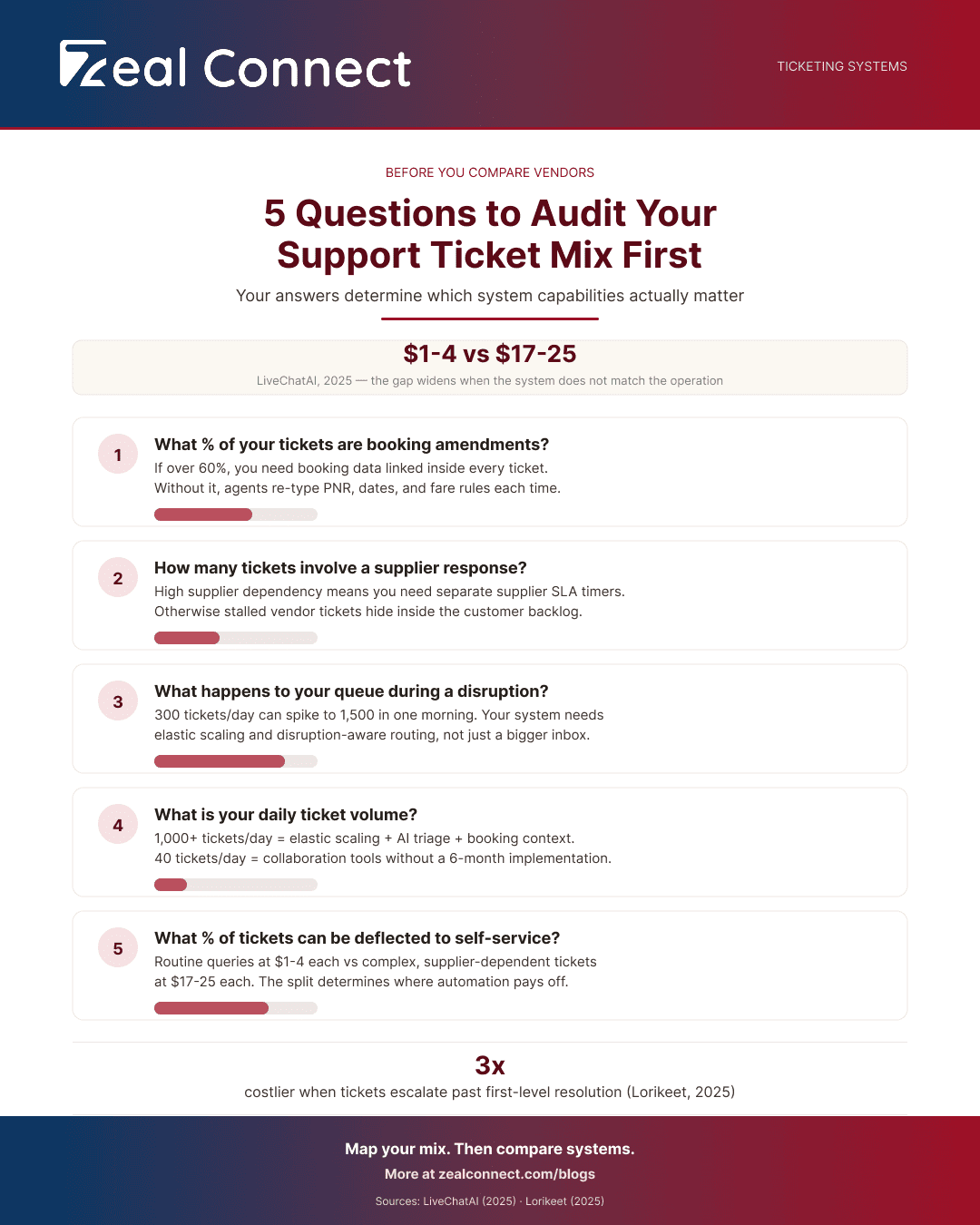
The ticketing system examples in this article show that leading travel companies did not start with a feature checklist. They started with their own operation: what kind of tickets they handle, how many, how dependent each ticket is on a supplier response, and what happens during a disruption. That is the sequence that works.
Match Ticketing System Examples to Your Sub-Vertical
A high-volume OTA processing 1,000+ tickets per day needs elastic scaling, AI-assisted triage, and booking data inside every ticket. A 20-person DMC running 40 supplier emails per day needs collaboration tools and supplier-response tracking without a six-month implementation. According to Lorikeet (2025), escalated support requests cost three times more than first-level resolutions. That multiplier means routing and first-contact resolution matter more than channel count or AI features for most mid-size travel operations.
Start with Your Ticket Mix Before Comparing Ticketing Systems
Before comparing vendors, categorize your own tickets. What percentage are booking amendments? How many are refund or chargeback requests? How many involve supplier coordination? The answer determines which ticketing system software strengths matter. If 60% of your volume is booking amendments, a system that cannot link tickets to live booking data will force your agents to work around it on every interaction. According to LiveChatAI (2025), self-service portals deliver resolution at $1 to $4 per ticket, while phone support costs $17 to $25. That cost difference means the system's self-service and automation capabilities matter most for routine queries, while agent-facing features matter most for complex, supplier-dependent tickets.
If 60% of your volume is booking amendments, a system that cannot link tickets to live booking data will force agents to work around it on every interaction.
How Does Zeal Desk Handle Ticketing System Examples That Horizontal Platforms Cannot?
The ticketing system examples above show a common pattern: horizontal platforms like Zendesk, Freshdesk, and Zoho Desk handle conversations well, but they do not know what a booking is. Travel-specific workflows (amendment cascades, supplier chasing, disruption triage) become custom integrations or manual workarounds. Zeal Desk is built only for travel operations, so these workflows run inside the ticketing system instead of beside it.
How Does Zeal Desk Connect Ticketing to Live Booking Data?
Zeal Desk registers external booking APIs, pulls live reservation records, and maps them onto ticket fields automatically. When a ticket arrives, the agent and the AI layer see the actual PNR, check-in/out dates, supplier references, and fare rules inside the ticket. A horizontal desk cannot do this without custom middleware, because it treats every inbound message as a flat conversation with no booking context. That difference determines whether automation (routing, SLA timers, AI classification) works on real data or on manually re-typed summaries.
How Does Zeal Desk Handle the Supplier Coordination That Ticketing Systems Miss?
Zeal Desk treats the supplier as a first-class participant in the ticket lifecycle. Parent/child ticket linking keeps a booking and its amendments connected as one case. Supplier SLA timers track the vendor's response separately from the customer's SLA, so stalled supplier tickets surface instead of hiding inside the backlog. Horizontal tools like Freshdesk or Zendesk model every participant as "the customer." They have no concept of a supplier leg with its own SLA.
How Does Zeal Desk's AI Work Inside the Ticketing System Without Replacing the Agent?
Zeal Desk's AI layer handles classification (sorting tickets by type and urgency), field extraction (pulling dates, PNR codes, and amounts from inbound messages), and smart summaries of long supplier threads. It drafts a response. The agent reviews it, edits it, and sends it. The AI never sends a customer-facing reply on its own. That distinction matters because travel tickets carry financial and regulatory weight. A wrong refund or a missed amendment deadline is not just a CSAT issue; it is a cost. According to Freshworks (2025), AI-powered tools have driven a 55% reduction in average first response time across support teams. In a travel operation, that speed gain only works when the AI assists the agent rather than replacing the human judgment behind the reply.
Conclusion
Ticketing system examples in travel are not product rankings. They are operational decisions shaped by each company's sub-vertical, ticket volume, supplier dependency, and disruption exposure. An OTA handling 2,000 tickets per day chose Zendesk or Salesforce for scale and invested in custom integration. A DMC running 40 supplier emails daily chose Hiver or Front for simplicity. A travel operation that needs booking data inside every ticket, supplier SLA tracking, and AI that assists without overstepping chose a travel-native platform. The right ticketing system is the one that fits how your operation actually works, not the one with the longest feature list. Start by mapping your own ticket mix and supplier dependencies. Then compare the examples above to an operation that looks like yours.
Frequently Asked Questions
What is a ticketing system in travel, and how is it different from airline ticketing?
A ticketing system in travel support is software that tracks, assigns, and resolves customer service requests in a queue. Airline ticketing is a separate process: it issues the ticket itself through a GDS (Amadeus, Sabre, Travelport) and handles fare rules and BSP/ARC settlement. Support ticketing manages what happens after the booking, when something goes wrong and a traveler or supplier needs help.
Which ticketing system do most OTAs use for customer support?
Most large OTAs use Zendesk or Salesforce Service Cloud for their scale and API ecosystem. Mid-size OTAs often choose Freshdesk or Kapture CX for faster setup and lower implementation costs. The choice depends on ticket volume, supplier complexity, and how much custom integration the team can maintain. Travel-native platforms like Zeal Desk handle booking workflows without that custom build.
Can a small travel company use a free or low-cost ticketing system?
Yes. Zoho Desk, Freshdesk, and Hiver all offer free or low-cost tiers that work for teams under 10 agents. Hiver runs inside Gmail, so there is no new interface to learn. The trade-off is that these ticketing system apps lack booking-aware features. As volume grows past 100 tickets per day, most teams hit a ceiling where manual workarounds for booking data and supplier tracking slow the operation.
What features should a ticketing system have for travel operations?
The features that matter most are booking-data linking (connecting each ticket to a live reservation), supplier SLA tracking (monitoring vendor response times separately), multi-channel intake (email, WhatsApp, chat, phone in one queue), AI-assisted triage (classifying and routing tickets by type and urgency), and disruption handling (absorbing sudden volume spikes without losing SLA visibility).
How does AI change ticketing system examples in travel?
AI handles classification, data extraction, and draft responses, which cuts the manual work per ticket. According to Freshworks (2025), AI-powered tools drove a 55% reduction in first response time. But in travel, AI assists the agent rather than replacing the decision. The agent reviews every draft, edits it, and sends it. AI never resolves or closes a ticket on its own.